Key Takeaways
- ABC National reports that merit shop apprenticeship enrollment has grown by roughly 60% nationally since the early 2020s, signaling a workforce shift that North and South Carolina contractors cannot afford to ignore in 2026.
- Apprenticeship and safety are inseparable strategic issues: a well-run registered apprenticeship program standardizes how new workers learn tasks, tools, and hazard recognition, reducing incidents on projects in Charlotte, the Triangle, and Upstate South Carolina.
- ABC Carolinas operates employer-sponsored apprenticeship and craft education options that plug directly into members’ safety programs, helping job seekers and career seekers enter commercial construction without college debt.
- Contractors should align HR, safety, and operations leaders now to take full advantage of 2026–2027 apprenticeship opportunities and evolving federal registered apprenticeship policies.
- ABC Carolinas members can combine apprenticeship resources, construction safety training resources, and peer groups and networking to build a resilient, safety-first workforce pipeline.
Apprenticeship and Safety in 2026: Why Carolinas Contractors Should Care Now
The connection between apprenticeship and safety has never been more consequential for commercial contractors in the Carolinas. With more than 800,000 apprentices active annually across the United States and safety training recognized as essential in high-risk industries like construction, the question is no longer whether to invest in structured workforce development. The question is how fast you can scale it.
According to an ABC National news release, merit shop apprenticeship enrollment has grown by roughly 60% nationally and is expanding faster than union programs. While that figure reflects a broad national trend rather than a local count, the implications for North and South Carolina are direct and urgent. Registered apprenticeships are available in various industries, including construction, and the Carolinas’ commercial pipeline demands that contractors act on this momentum now.
Here is why this matters for your business right now:
- Rapid commercial growth along the I-85, I-77, and I-95 corridors, plus data center and healthcare work in the North Carolina Triangle and Charlotte metro, is driving sustained demand for skilled craft professionals.
- More first-year workers on site in 2026 raises both opportunity and risk. Without safety expectations built into training, contractors face higher exposure for recordable incidents and EMR increases.
- ABC National member companies invested approximately $1.6 billion in training, apprenticeship, and safety education in 2024 alone, reaching 1.3 million course attendees. That scale of commitment reflects an industry that understands apprenticeship programs are long-term investments in safety culture, quality, and competitiveness, not short-term hiring fixes.

How ABC Carolinas’ Apprenticeship Platform Works for Employers
ABC Carolinas connects member firms across North and South Carolina to registered apprenticeship programs and structured craft education, including classroom instruction, lab exercises, and NCCER-aligned curricula. Registered apprenticeship programs meet national quality standards, and the platform is built around the merit shop principle that employers compete on performance, not mandates.
Here is how it works for participating companies:
- Employers remain the apprentices’ primary sponsors and W-2 employers, responsible for wages, on-the-job training, and adherence to state and federal registered apprenticeship requirements. Training length varies from one to six years, depending on the trade and program design.
- Training calendars typically follow an academic-year rhythm with fall and spring cohorts. Companies planning for 2026 enrollment should start identifying candidates, budgeting, and coordinating schedules months in advance.
- ABC Carolinas staff help contractors design apprenticeship program standards, align related instruction with specific scopes of work such as commercial electrical, plumbing, carpentry, or heavy equipment, and document progression for each registered apprenticeship program.
- Programs can be customized for different segments: new job seekers straight out of high school, mid-career career seekers from other industries such as advanced manufacturing or logistics, and existing employees ready to formalize skills and advance into foreman or superintendent tracks.
- Employers can recruit through registered apprenticeship programs, making these platforms a structured pipeline rather than an ad-hoc hiring effort.
Why Registered Apprenticeship Programs Strengthen Jobsite Safety
How does a registered apprenticeship program improve safety? The answer is structural. Unlike informal on-the-job exposure, registered apprenticeships require documented training plans, defined supervision ratios that maintain journeyworker-to-apprentice levels, and measurable competency progression. This framework reduces the likelihood that inexperienced workers in Charlotte or Columbia are left to figure out ladders, scaffolds, or energized equipment on their own. Safety training significantly reduces workplace accidents, and apprenticeships combine on-the-job learning with safety training as a core design feature.
Registered apprenticeship programs meet national safety training standards. Here are the specific mechanisms that make them effective:
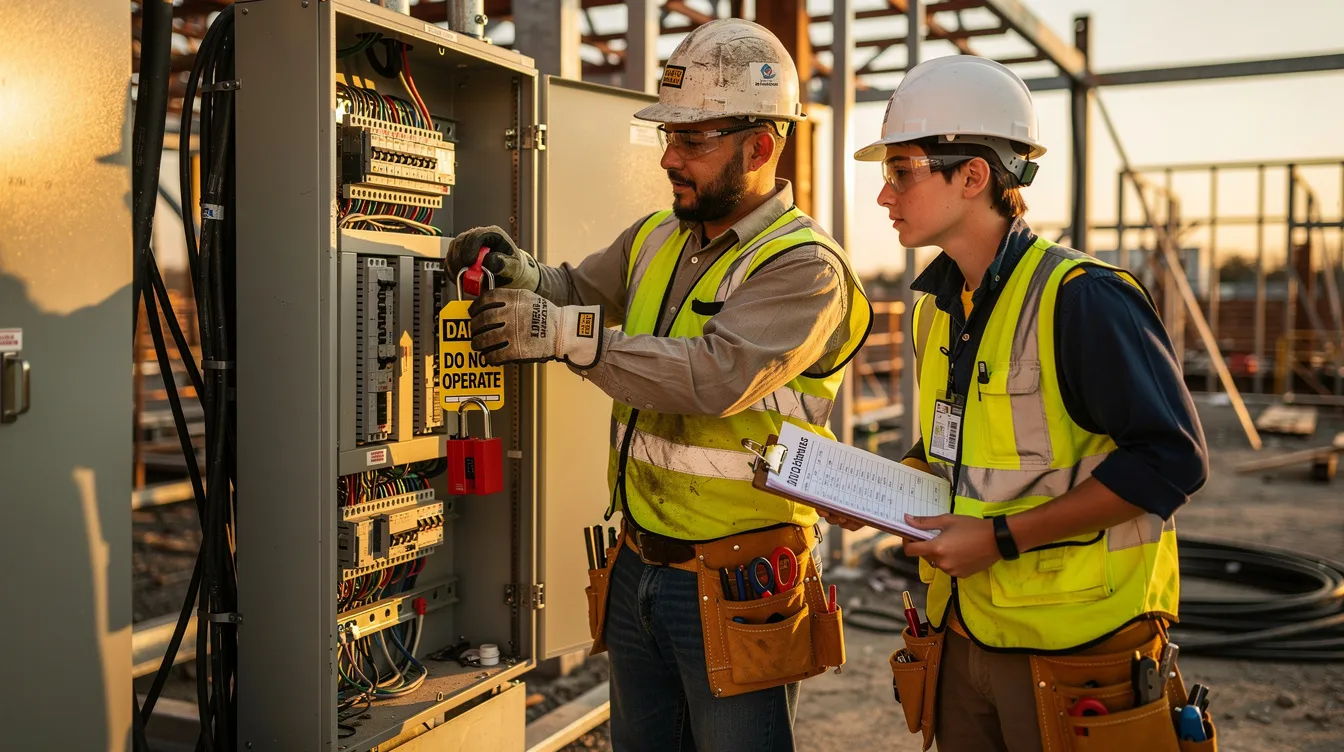
- Structured on-the-job learning pairs new apprentices with experienced journey-level mentors. Registered apprenticeship programs connect apprentices with experienced mentors who embed daily safety habits, including pre-task planning, PPE use, lockout/tagout, trench protection, and equipment inspection.
- Personal Protective Equipment requirements include role-specific gear. Apprentices should wear required PPE correctly and replace damaged gear immediately, and mentors enforce this standard daily.
- Enforce energy-isolation procedures before maintenance activities. Apprentices learn lockout/tagout protocols before they touch energized systems, not after an incident forces the lesson.
- Supervision ratios should maintain defined journeyworker-to-apprentice levels, ensuring no apprentice works beyond their current competency without qualified oversight.
- Apprentices must actively engage in safety onboarding as part of their training. This includes learning emergency exit paths, participating in drills, and understanding hazard communication protocols from day one.
- Routine emergency preparedness drills and clear reviews of evacuation routes are built into the program calendar, not treated as afterthoughts.
- Standardized classroom training covering hazard communication, fall protection basics, and confined space awareness helps flatten the learning curve for workers transferring across projects from the Triangle to the coast.
Consider this scenario: an electrical apprentice on a data center project along the NC I-85 corridor works under a journey-level electrician daily. Every energized task requires a lockout/tagout review. Every shift begins with a pre-task safety briefing. Because progression is documented, supervisors know exactly which tasks the apprentice is ready to handle and which require direct oversight. Over six to twelve months, that project sees fewer minor incidents, better audit compliance, and reduced corrective actions. That consistency is what separates structured apprenticeship from informal trial-and-error.
From Job Seekers to Career Seekers: How Apprenticeships Serve the Next Generation
Registered apprenticeships give job seekers in North and South Carolina an earn-while-you-learn path into commercial construction, helping them avoid college debt and enter fields like structural steel, electrical, HVAC, and sitework. Unlike a casual job, a registered apprenticeship is a structured career path: apprentices follow a multi-year progression with documented competencies, pay increases tied to skills, and clear expectations for advancement to journeyperson and foreman roles. When an apprentice completes the program, they hold a nationally recognized credential that travels with them across employers and geographies.
The economics are compelling:
- Apprentices earn an average starting salary of $86,000 when factoring in the full value of training, benefits, and wage progression across program years.
- Apprentices earn $300,000 more over their lifetime than peers who enter the workforce without structured credentialing.
- A North Carolina study found that registered apprenticeship participants were employed at a 90% rate five years after high school graduation, compared to 74% for similar non-participants, and earned roughly $14,500 more annually by that point.
- For comparison, states like Colorado report over 9,900 active apprentices in their programs, demonstrating the model’s scalability across regions.
- Events like the Apprenticeship Career Expo held on September 29, 2023, have helped connect career seekers directly with employers offering registered apprenticeship opportunities, and similar programming continues to expand nationally.
Contractors should market their apprenticeship opportunities as long-term careers, not entry-level positions, using concrete language around wages, credentialing, and safety training commitments. Registered apprenticeship programs appeal to diverse candidate pools, including veterans, career changers from manufacturing or information technology, and high-school graduates along the I-95 corridor who value stability, hands-on work, and employers that invest in their safety and growth. A high school diploma or equivalent is often listed as a minimum qualification, making these programs accessible while maintaining standards.
ABC Carolinas’ apprenticeship resources serve as a starting point for individuals and employers seeking additional information about registered apprenticeships and local program contacts.
What 2026 Apprenticeship Policy and Compliance Mean for Carolinas Employers
Federal agencies continue to emphasize quality, transparency, and timely approval for registered apprenticeship programs. The U.S. Department of Labor has committed to making registration decisions within 30 days of application, which directly affects how quickly Carolinas contractors can launch or modify programs. Ongoing national debates around the National Apprenticeship Act and related rulemaking continue to evolve, and ABC Carolinas monitors these developments and advocates for merit shop employers in Raleigh and Columbia.
What this means for your compliance posture:
- Employers should review sponsor responsibilities, recordkeeping, wage progression documentation, and equal opportunity requirements. Compliance with OSHA and local health standards is essential for workplace safety, and registered apprenticeship programs formalize many of these obligations.
- Employers must provide safety training in a language apprentices understand, a requirement that is both a federal standard and a practical necessity on diverse job sites.
- Documentation of safety training and incident reports is necessary for compliance, and programs that fail to maintain these records risk penalties, contract issues, or disqualification for public work.
- Treat any plan to start a registered apprenticeship program as a multi-department project. HR, risk management, safety, and operations should coordinate from the start, not hand off responsibilities after registration is complete.
Designing Apprenticeship Programs Around Safety Culture, Not Just Skills
An apprenticeship program that only teaches trade skills misses half the opportunity. The real leverage comes from using apprenticeship as a vehicle for building a safety-first culture visible to new hires from day one.
Here is how to embed safety culture into program design:
- Start every classroom instruction session with a safety moment. Tie each new task introduced in related instruction to a specific job hazard analysis.
- Require apprentices to participate in job safety analyses and near-miss reporting as part of their assessed competencies, not optional extras.
- Establish clear communication channels for reporting hazards without fear of retribution. Apprentices should ask questions to clarify hazardous tasks directly with supervisors, and programs should normalize that expectation.
- Safety training should be updated as apprentices change duties or encounter new hazards. A first-year apprentice working on sitework faces different risks than a third-year apprentice pulling cable in a mechanical room.
- Apprentices should have the authority to stop work if they identify an unsafe condition. This principle, taught early and reinforced by mentors, distinguishes a genuine safety culture from a poster on the wall.
- Foremen and superintendents serve as culture carriers. If they were themselves products of strong apprenticeship programs, they are more likely to enforce safety rules consistently and mentor new workers effectively.
Firms working on high-risk projects, whether multi-story office builds in Uptown Charlotte or bridge work over I-26, stand to gain the most from aligning apprenticeship content with rigorous internal safety expectations.
Practical Steps for North and South Carolina Contractors Before the Next Enrollment Cycle
If your company plans to participate in the next apprenticeship enrollment cycle, start preparing now. Here is a practical checklist:
- Conduct a workforce gap analysis by craft, geography, and project type. How many electricians, pipefitters, or carpenters do you need for planned 2027 projects in the Triangle versus your current staffing and pipeline?
- Appoint an internal apprenticeship lead or committee that includes HR, safety, and field operations. This team owns program design, scheduling, and coordination with ABC Carolinas.
- Align apprenticeship curriculum plans with your company’s safety program. Ensure apprentices complete key safety courses like OSHA outreach education early in their progression.
- Prepare your foremen and field leaders through targeted construction leadership training. Effective front-line leaders are critical to apprenticeship success because they translate program standards into daily jobsite behavior.
- Budget strategically. Apprentice wages, training time, supervisory costs, and equipment for learners are investments that return lower turnover, better safety performance, and stronger project delivery capacity. These are not overhead; they are capacity costs.

The Business Case: How Apprenticeship and Safety Drive Merit Shop Competitiveness
Firms with stable apprenticeship pipelines can staff multiple projects across Charlotte, the NC data center corridor, and Upstate South Carolina more reliably, reducing reliance on last-minute hiring or temporary labor. That reliability translates directly into business outcomes:
- Fewer recordable incidents and stronger safety performance help lower insurance costs, preserve or improve EMR, and make companies more competitive on prequalification for public and private work. ABC members who earned Diamond status in ABC’s STEP safety program were nearly six times safer than the industry average.
- Clients in healthcare, industrial, and mission-critical markets increasingly ask about workforce development and safety metrics during procurement. Robust apprenticeship and safety programs are clear differentiators when you are seeking to win complex work.
- Apprenticeship supports succession planning. Today’s apprentices become tomorrow’s foremen, superintendents, and project managers, stabilizing leadership ranks in merit shop firms across the Carolinas.
- Open competition and free enterprise reward contractors who build internal capacity. Strong training and safety programs help members win work based on performance, not mandates or affiliations.
Leveraging ABC Carolinas Networks, Peer Groups, and Apprenticeship Resources
ABC Carolinas is more than a training provider. It is a hub for workforce and safety collaboration. Members can explore peer groups and networking opportunities where contractors compare apprenticeship strategies, safety practices, and technology use with regional peers. Networking events are crucial for career seekers in apprenticeships and equally valuable for employers benchmarking their programs.
- Events and regional councils across Charlotte, the Triangle, and South Carolina provide forums where members share lessons learned from launching and scaling registered apprenticeship programs.
- Members can access apprenticeship resources such as sample standards, implementation checklists, and introductions to education partners to avoid common startup mistakes.
- Contact ABC Carolinas staff for additional information on integrating apprenticeship opportunities, safety training, and leadership development into your 2026–2027 business plans.
How Apprenticeship Programs Support Retention, Engagement, and Mental Wellbeing
Retention is one of the most undervalued returns on apprenticeship investment. Nationally, 93% of apprentices retain employment after completing their program. Employees in registered apprenticeship programs stay because they see a defined path forward with pay progression, credentialing, and advancement tied to demonstrated skills and safe performance. That paycheck is connected to real growth, not just hours logged.
- Structured mentorship and regular check-ins create natural touchpoints for supervisors to spot stress, fatigue, or burnout, factors that affect both safety and productivity.
- Some ABC Carolinas members pair apprenticeship with broader workforce initiatives such as toolbox talks on mental health or access to employee assistance programs, supporting whole-person wellbeing in the workplace.
- Companies that invest visibly in their people’s development enjoy stronger morale, better teamwork on complex projects, and more positive word-of-mouth among potential apprentices and career seekers. That reputation compounds: the best new candidates want to work for firms that care about their future.
Conclusion: A 2026 Roadmap for Apprenticeship and Safety in the Carolinas
Rising apprenticeship enrollment nationally, combined with strong construction demand in the Carolinas, makes 2026 a pivotal year for contractors to formalize their workforce and safety strategies. The firms that learn new skills in program management, align their foremen with training expectations, and prepare their teams now will be the ones staffing 2027 projects with confidence and fewer incidents.
ABC Carolinas stands ready to help firms design or expand registered apprenticeship programs, integrate safety into every step of training, and align these efforts with broader business and advocacy goals. Whether you need to find registered apprenticeship opportunities, recruit new apprentices, or support employees already eligible for advancement, the infrastructure is in place.
Review ABC Carolinas’ apprenticeship and safety offerings. Connect with staff for a program consultation. Plan now for the next enrollment cycle so your teams, your resume of completed projects, and your safety record are ready for 2027 and beyond.
FAQ: Apprenticeship and Safety for Carolinas Contractors
How long does it typically take to see safety improvements after launching an apprenticeship program?
Some benefits appear within the first six to twelve months, particularly more consistent orientation, supervision, and hazard recognition among new workers. Measurable changes in incident rates, EMR, and insurance costs often take multiple years of consistent apprenticeship and safety investment, sustained mentorship, and leadership commitment to a safety-first culture.
Can small contractors with fewer than 25 employees realistically sponsor a registered apprenticeship program?
Yes. Many small and mid-sized firms participate either as individual sponsors or through group and consortium-style programs coordinated by associations like ABC Carolinas. The Department of Labor framework accommodates flexible program designs. Interested firms should contact the chapter for guidance on right-sizing an apprenticeship approach that fits their workforce and budget.
How do registered apprenticeships interact with existing in-house safety and skills training?
Registered apprenticeship programs generally formalize and document what many contractors already do informally. Employers can align their internal safety courses, toolbox talks, and vendor-funded trainings with the related instruction and on-the-job training requirements. The registration process does not replace your existing program; it strengthens it with accountability, progression tracking, and a certificate of completion.
Are there apprenticeship options for non-traditional candidates, such as career changers or veterans?
Registered apprenticeships are open to anyone legally eligible to work in the United States who meets employer qualifications, including veterans and mid-career professionals from industries like hospitality, transportation, or manufacturing. Many Carolinas contractors actively recruit such candidates for their maturity, discipline, and safety mindset. These individuals often prove to be a good fit for structured training environments.
What is the most practical first step if my company has never used apprenticeship before?
Start with an internal review of workforce needs and safety priorities. Identify which crafts, project types, and geographies have the biggest gaps. Then schedule a conversation with ABC Carolinas staff to explore appropriate registered apprenticeship programs, participation models, timelines, and available apprenticeship resources. That initial consultation costs nothing and can save months of trial and error.


