The federal government is still working to define which waters and wetlands fall under Clean Water Act jurisdiction, and every revision changes the permitting landscape for commercial construction in the Carolinas. Here is what North and South Carolina contractors need to know right now.
Key Takeaways
Changes to the Waters of the United States definition directly affect how commercial construction projects in the Carolinas move through permitting, from sitework and grading to utility crossings and stormwater management. WOTUS stands for Waters of the United States, and it is the key standard for defining scope under the Clean Water Act. Because WOTUS determines which water bodies receive federal protection, every shift in that definition reshapes project timelines, costs, and risk across our region.
- The September 3, 2026 EPA and Army Corps of Engineers supplemental notice keeps the WOTUS definition in active flux, meaning contractors should treat jurisdictional determinations and permit requirements as a live risk factor through 2026 and into 2027.
- The United States Supreme Court’s Sackett v. EPA decision narrowed federal wetland jurisdiction by rejecting the significant nexus test, but left room for interpretation around continuous surface connection, which still drives many Army Corps decisions on Carolinas job sites.
- For North and South Carolina projects in growth corridors around Charlotte, the Triangle, and the Upstate, WOTUS uncertainty can extend permitting timelines, affect bid contingencies, and compress schedule buffers on sitework and infrastructure packages.
- Narrowing the definition of WOTUS limits federal clean water protections, but states can still regulate wetlands despite changes in federal jurisdiction, creating overlapping compliance obligations.
- ABC Carolinas members should review 2026 project assumptions now, coordinate with environmental consultants early, and follow ABC Carolinas government affairs updates for evolving federal and state law changes.
WOTUS in 2026: Why It Matters for Carolinas Commercial Construction
In plain language, WOTUS defines which waters fall under federal Clean Water Act jurisdiction. If a body of water qualifies as WOTUS, certain activities become subject to federal permitting, and agencies issue permits under the Clean Water Act for discharges or fill placed into streams, wetlands, or other covered features during construction. That single classification decision can determine whether your project needs weeks of additional review or can proceed on schedule.
- WOTUS determines whether the Environmental Protection Agency and the U.S. Army Corps of Engineers have primary authority over grading, fill, utility crossings, and stormwater features on commercial sites across the United States.
- Protected waters help keep drinking water safe for communities and sustain water quality and water resources that affect downstream landowners and municipalities.
- WOTUS includes tributaries and adjacent wetlands under federal protection, so even features that look minor on a site plan can pull a project into federal review.
- WOTUS impacts compliance costs for developers, farmers, and industries, making the definition a significant cost driver well beyond the construction industry.
Ambiguity in the Clean Water Act has led to legal battles over WOTUS for decades. This has been a topic of regulatory controversy across presidential administrations, with each administration attempting to revise or clarify the rule. The September 3, 2026 EPA and Army Corps supplemental notice is the latest procedural step, designed to align the proposed rule with Supreme Court precedent rather than deliver a complete reset of permitting programs. It keeps rulemaking and guidance in motion through 2027.
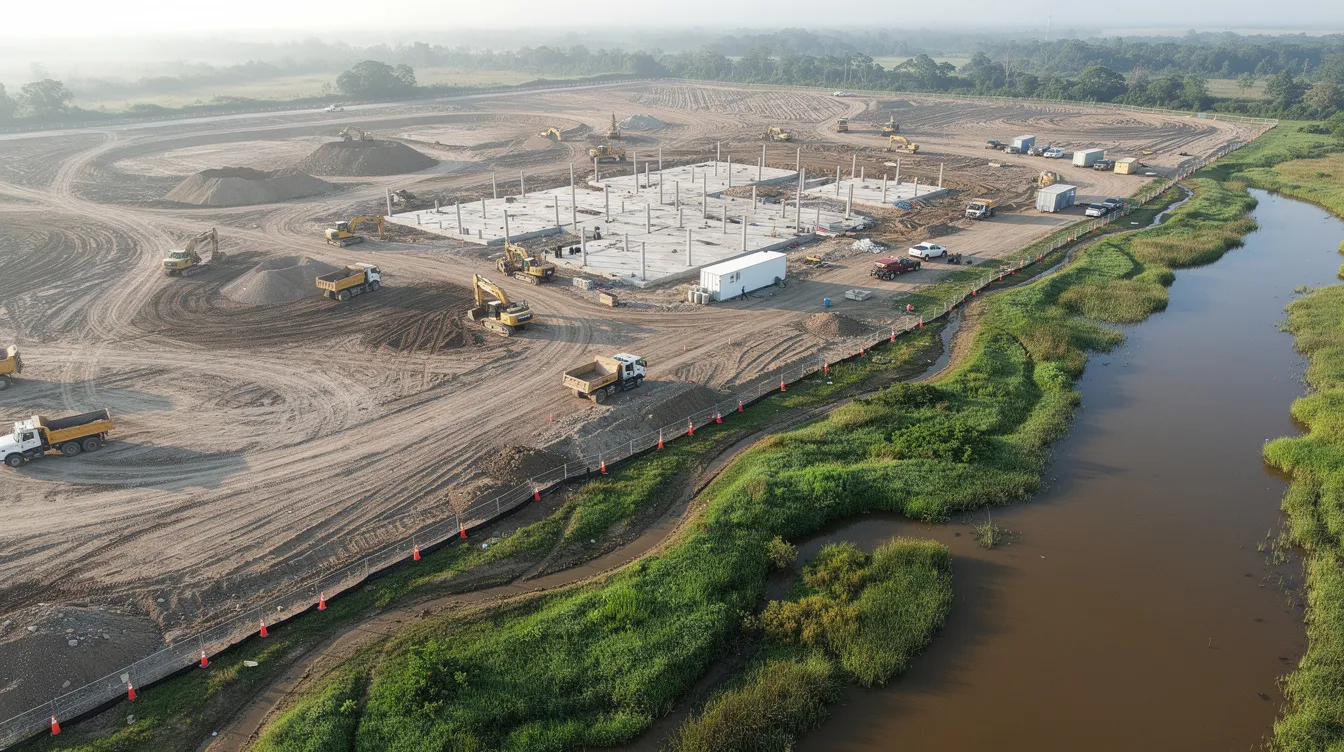
Even projects that are not “water” projects can be pulled into federal review. A tilt-wall warehouse on a greenfield tract may sit near a ditch with perennial flow. A medical office building site may contain a headwater stream buried under decades of fill. Data centers in central North Carolina’s Piedmont often encounter wetland features during early grading. In each case, the WOTUS classification of that feature determines the permitting path, the schedule risk, and the cost assumptions your team carries into a bid.
Quick Refresher: Sackett, Significant Nexus, and the Current Legal Baseline
In May 2023, the Supreme Court decided Sackett v. EPA, a case that reshaped how federal jurisdiction applies to wetlands across the country. Every Carolinas contractor should understand the basics, even without reading the full opinion, because the decision changed which site features trigger federal permits and which do not.
- Before Sackett, the federal government could assert CWA jurisdiction over wetlands that had a significant nexus to navigable waters, a broad standard based on Justice Kennedy’s concurrence in the 2006 Rapanos case. The 2023 Rule had combined Justice Scalia’s and Justice Kennedy’s WOTUS approaches into a single framework.
- The court found that wetlands must now have a continuous surface connection to relatively permanent tributaries, standing, or continuously flowing waters to fall under federal jurisdiction. The decision rejected the significant nexus test for wetlands, replacing it with this narrower physical standard.
- Sackett v. EPA limited federal jurisdiction over certain wetlands nationwide, meaning that wetlands connected to navigable waters only through groundwater, subsurface flow, or ecological function no longer automatically qualify for federal protection.
- The 2023 Rule removed the significant nexus test from the WOTUS definition, and the Sackett decision prompted the EPA to revise the 2023 Rule further. The EPA had initially planned to develop new guidelines by September 1, 2023, though implementation has extended well beyond that date.
- Federal rules now target relatively permanent and continuously flowing waters plus adjacent wetlands that are indistinguishable from those waters. However, key terms like continuous surface connection and relatively permanent remain partly undefined by the Supreme Court, which is why the EPA and Army Corps continue to issue guidance and case-by-case jurisdictional determinations.
The definition of WOTUS has shifted because of these Supreme Court rulings, and the Sackett decision limited federal CWA jurisdiction over wetlands in ways that officials in district offices across the Carolinas are still interpreting. Although Sackett removed the significant nexus test from federal use, some state law and local requirements can still regulate isolated wetlands and ephemeral features separately from federal WOTUS.
What the September 3, 2026 EPA/Army Supplemental Notice Actually Does
On September 3, 2026, the EPA and Department of the Army agencies issued a supplemental notice of proposed rulemaking to gather additional input on alternatives to the 2025 proposed rule. This joint action is designed to refine the WOTUS definition and its implementation in light of Sackett and recent litigation, not to finalize a new rule overnight.
- The agencies proposed multiple alternatives for how key terms are defined, including “perennial” (water flowing every day during ordinary conditions), “relatively permanent” (perennial except during drought or interruptions no longer than 30 days), and “continuous surface connection” (wetlands continuously connected via surface water, with narrow exceptions for brief interruptions).
- One alternative would eliminate “adjacent wetlands” as a regulatory category entirely, limiting jurisdiction only to wetlands that are indistinguishably part of a covered waterbody.
- The notice seeks to clarify how agencies evaluate connections between tributaries, ditches, and downstream waters, and to align jurisdictional procedures across regions.
- A jurisdictional determination may be necessary for unclear WOTUS features on any given project, and the supplemental notice acknowledges that federal jurisdiction over certain streams and wetlands could drop materially under some alternatives.
This proposal does not instantly rewrite every permit program. Instead, it sets up further public comment (a 30-day window after Federal Register publication), additional guidance, and potential adjustments to jurisdictional determination practices through late 2026 and 2027. Permit applicants in North and South Carolina should expect Army Corps and EPA reviewers to rely on updated guidance as it is released, which can subtly change how similar sites are treated compared with 2022 or early 2023. ABC Carolinas will track how this notice translates into field-level decisions in the Wilmington, Charleston, and Savannah district offices that routinely handle Carolinas construction projects.
Where WOTUS Shows Up on Carolinas Job Sites
A typical Carolinas project team encounters WOTUS during site selection, preliminary grading plans, wetland delineations, and early coordination meetings with owners and consultants. The question is straightforward: does this site contain jurisdictional waters or wetlands that require federal or state permits before earthwork begins?
- Common features that can trigger federal jurisdiction include roadside ditches with perennial flow, headwater streams on Piedmont tracts, Carolina bays, coastal marshes near industrial sites, and man-made ponds connected to navigable waters.
- Section 404 permits are required for wetland impacts and for discharging fill material into jurisdictional waters. Fines for not obtaining a Section 404 permit can reach $37,500 daily, a risk no contractor or owner can afford to ignore.
- Wetland delineations help minimize impacts on WOTUS features by mapping exactly where jurisdictional boundaries fall. The minimum impact threshold for wetlands is 0.10 acres, meaning even small encroachments can trigger federal review.
- The impacts differ by stakeholder. Owners face delays in entitlements and financing. General contractors absorb overall schedule risk. Sitework and utility subcontractors must resequence crews and equipment. Material suppliers deal with delivery timing and staging constraints when mobilization dates shift.
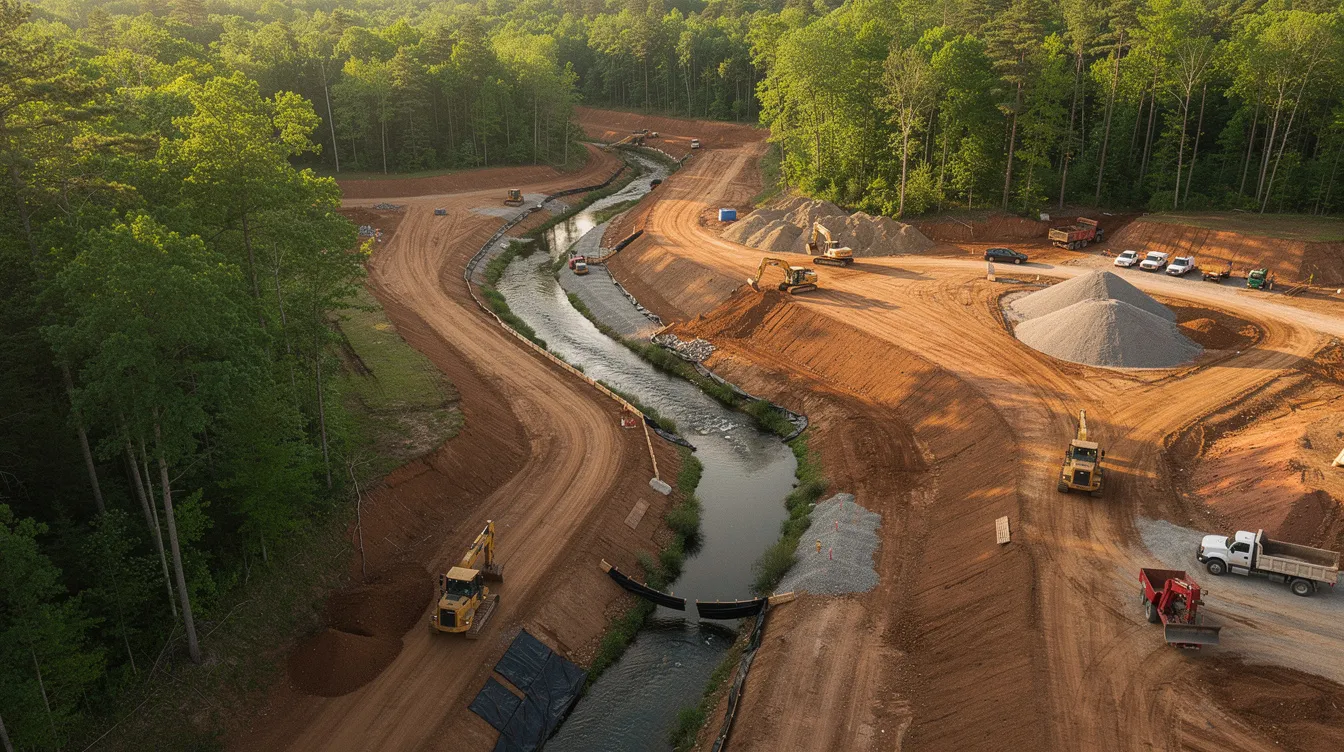
An unexpected Army Corps jurisdictional determination can delay mobilization by weeks or months, forcing resequencing of earthwork, foundation packages, and vertical trades. The downstream cash-flow effects ripple through the entire project team. WOTUS issues also influence erosion and sediment control designs, stormwater management strategies, and the need for Section 404 permits or state equivalents before mass grading can begin.
Project Types in the Carolinas Most Exposed to WOTUS Uncertainty
Not all projects carry the same WOTUS exposure. Understanding risk by project type helps contractors price and schedule responsibly, rather than applying blanket contingencies across every bid.
- Highway and interchange expansions along the I-85 and I-77 corridors, greenfield industrial parks outside Charlotte and in the Upstate, distribution centers along I-95, and data centers in central North Carolina all sit in areas where streams, wetlands, and drainage features are common.
- Public infrastructure projects (road widenings, water and sewer extensions, airport expansions, port-related logistics facilities, and transportation projects) almost always intersect with jurisdictional waters and require Army Corps review. These projects involve determining jurisdiction over features that may not be obvious during early planning.
- Redevelopment and adaptive reuse sites in older industrial corridors can raise WOTUS questions because legacy drainage systems, canals, and wetlands were previously filled or altered. Even land that appears fully developed can harbor features that trigger review.
- Carolinas contractors should treat early-stage earthwork and utility packages on these higher-exposure projects as WOTUS-sensitive, building in extra time for delineations, coordination, and potential Army Corps feedback.
Permitting Timelines, Bid Contingencies, and Schedule Buffers in 2026
WOTUS is fundamentally a forecasting issue: how long will permits take to obtain, how much schedule float is realistic, and what level of pricing contingency is prudent?
- A typical sequence for projects needing federal or state water-related permits runs from an initial site walk and desktop review to wetland delineation, Army Corps jurisdictional determination, permit application and public comment, and finally approval. Initial permit evaluations can take two to eight weeks, and more complex reviews can take much longer.
- Permit fees are based on construction valuation and square footage, adding direct cost to any project that requires a Section 404 or state equivalent process.
- Estimators and preconstruction teams should translate WOTUS-related uncertainty into bid assumptions by adding specific contingencies for permit-related delays, clarifying exclusions and allowances in proposals, and tying certain start dates to receipt of final permits.
- Project teams should align WOTUS-related buffers with broader market intelligence from ABC Carolinas’ mid-year economic forecast, so schedule and cost assumptions reflect both regulatory and market-driven risks.
- Clearly documented WOTUS assumptions in bids and contracts reduce disputes later, since owners and general contractors have a shared record of what was known and assumed at the time of pricing.
Coordinating Federal, State Law, and Local Requirements in North and South Carolina
Even when federal WOTUS jurisdiction narrows, state law and local requirements still shape how water and wetlands are regulated on Carolinas job sites. Contractors who assume “non-WOTUS” means “no permit” risk stop-work orders and redesigns.
- North Carolina’s environmental agencies and South Carolina’s Department of Environmental Services administer programs related to wetlands, stormwater, and sedimentation in addition to federal oversight by the EPA and Army Corps of Engineers.
- The 2023 NC Farm Act restricts the state wetlands definition to align with the federal WOTUS definition, meaning that as federal definitions narrow, North Carolina’s state-level protections contract correspondingly. This reduces the state’s ability to regulate isolated wetlands like pocosins or freshwater swamps independently.
- States can still regulate wetlands despite federal jurisdiction limits. South Carolina municipalities like Mount Pleasant and Bluffton have adopted local wetland protection ordinances, including buffer requirements around on-site wetlands, to fill gaps left by federal narrowing.
- Changes in federal jurisdiction, combined with state legislative actions, can shift the balance between federal permits and state certifications, creating new gray areas that require early coordination with regulators and consultants.
- Contractors should map out all overlapping approvals early in preconstruction for 2026 projects. County, municipal, and regional stormwater programs may add layers of review, permit types, and compliance obligations beyond what federal WOTUS rules require.
Practical Steps Carolinas Contractors Can Take Now
While contractors cannot control federal rulemaking, they can significantly reduce WOTUS-related risk through disciplined planning and communication. The process starts before you close on land or finalize a site plan.
- Commission early wetland and stream delineations on candidate sites. Request preliminary jurisdictional reviews before final land acquisition. Involve environmental consultants in conceptual site plans so that jurisdictional questions surface before, not after, preconstruction budgets are set.
- A jurisdictional determination may be necessary for unclear WOTUS features, and requesting one early gives your team time to respond before the schedule is locked.
- Estimators, project managers, and in-house counsel or outside attorneys should jointly review standard contract language to ensure WOTUS-related delays, permit denials, and mitigation costs are allocated fairly between owners, general contractors, and subcontractors.
- Incorporate WOTUS checks into broader strategic planning for 2026, so that regulatory risk and market dynamics are evaluated together rather than in separate silos.
- Assign an internal point person to monitor WOTUS-related updates and ABC Carolinas government affairs alerts. Project teams should receive timely briefings rather than piecemeal news.
How ABC Carolinas Supports Members on WOTUS and Environmental Permitting
ABC Carolinas is a regional trade association focused on advocacy, education, and risk management support for merit shop contractors across North and South Carolina. WOTUS is one of several regulatory issues the association works to keep members informed and prepared for.
- ABC Carolinas integrates WOTUS developments into broader construction risk management programming, including webinars, member roundtables, and conference sessions that decode new EPA and Army Corps guidance for operations teams.
- The government affairs staff monitors regulatory and legislative activity in Raleigh and Columbia, alongside federal updates, and folds WOTUS issues into ongoing merit shop advocacy efforts that defend open competition and predictable permitting for businesses across the region.
- Education and workforce development programs can incorporate environmental permitting considerations into project management, preconstruction, and leadership training, helping mid-career leaders recognize WOTUS red flags earlier.
- WOTUS is part of a larger risk and cost picture that ABC Carolinas addresses through resources covering construction material cost risks, mid-year economic forecast insights, and policy-focused briefings.

What to Watch Next: Federal and State Policy Signals for 2026–2027
The September 3, 2026 supplemental notice is not the end of the WOTUS conversation. More guidance, potential litigation, and state-level responses will shape the regulatory landscape through 2027 and beyond.
- Watch for follow-up EPA and Army Corps guidance documents that translate the proposed rule alternatives into field-level instructions for district offices, including guidance and rulemaking responses issued after United States Supreme Court decisions. Public comment windows on any proposed rule refinements will offer opportunities to provide input.
- Court challenges are likely against whichever version becomes final, whether from environmental groups arguing for broader protections or from developers and landowners seeking narrower definitions. Litigation could stay or modify the evolving WOTUS definition.
- In North Carolina, monitor whether state legislators adjust the Farm Act’s alignment with federal definitions or whether agencies adopt new rules for isolated wetlands. In South Carolina, watch for additional municipalities adopting local wetland ordinances or buffer requirements.
- Integrate these policy watchpoints into annual business planning cycles. Revisit project assumptions regularly as new regulations, guidance, and court rulings emerge.
- Deepen involvement with ABC Carolinas’ merit shop advocacy efforts so that Carolinas contractors have a unified voice on WOTUS and related permitting reforms in Raleigh, Columbia, and Washington.
Next Steps for Carolinas Construction Leaders
Permitting timelines, bid risk, schedule reliability, and competitive positioning in a fast-growing regional market all connect back to how your firm handles WOTUS uncertainty. The contractors who plan for that uncertainty will comply more efficiently, bid more accurately, and avoid costly surprises.
- Review your 2026 and 2027 project pipelines for WOTUS-sensitive sites. Flag any projects with streams, wetlands, ditches, or detention features that could trigger jurisdictional review.
- Update internal checklists for early environmental due diligence. Make sure your site selection and preconstruction processes include a WOTUS screening tool before land acquisition decisions are final.
- Align bid language with current federal and state law assumptions. Document what you know and what you are assuming about permit requirements at the time of pricing.
- Brief your estimating, project management, and preconstruction teams on WOTUS basics using ABC Carolinas briefings and events as efficient training opportunities, rather than expecting staff to decode legal documents and regulations on their own.
- Build WOTUS and environmental permitting considerations into your broader construction risk management structure, alongside labor, supply chain, and materials cost pressures.
Stay subscribed to ABC Carolinas regulatory updates, attend advocacy-oriented events, and participate in member peer groups where WOTUS permitting uncertainty and other policy challenges are discussed in real time. Firms that engage early will be best positioned to win work and deliver projects on time.
Frequently Asked Questions About WOTUS and Carolinas Construction
Below are answers to common questions about this topic.
Does every commercial project in the Carolinas need a WOTUS-related permit?
No. Many vertical projects on previously disturbed urban or suburban sites will not trigger federal WOTUS jurisdiction, especially if no wetlands or streams are present. However, evaluate any project involving grading near streams, ditches, or wetlands early. Even sites that appear fully developed can contain features connected to navigable waters. If a body of water is classified as WOTUS, it requires federal permits for pollution activities, including discharging pollutants or fill material, so a quick screening is always worthwhile.
How long should we plan for Army Corps jurisdictional determinations in 2026?
Plan for several weeks to several months. Initial permit evaluations can take two to eight weeks, but actual timelines vary by district workload, project complexity, and the clarity of submitted delineations. In high-growth corridors where review queues are longer, adding buffer time to your schedule is essential. Projects with complicated hydrology or multiple water features will take longer to process.
Can state or local regulators still restrict work even if a feature is not WOTUS?
Yes. States can still regulate wetlands despite federal jurisdiction limits. North Carolina’s Sedimentation and Pollution Control Act and coastal management programs can regulate activities in non-federal wetlands and streams. South Carolina municipalities have adopted local ordinances with buffer requirements and mapping tools. Contractors must confirm all layers of regulation, including county and municipal stormwater programs, rather than assuming that a non-WOTUS determination means no permit is needed.
Who on our team should own WOTUS risk management?
Assign primary responsibility to a preconstruction or project executive leader who coordinates with estimators, project managers, environmental consultants, and legal advisors. This person should ensure that jurisdictional questions are handled systematically during site evaluation and bid preparation, not addressed ad hoc after a surprise finding during grading. That approach keeps air quality, water quality, erosion control, and other factors aligned in one review process.
How can ABC Carolinas help if we hit a WOTUS-related roadblock on a project?
While ABC Carolinas does not provide legal representation, the association can connect members with peer experience through services like roundtables and peer groups. The government affairs team shares regulatory intelligence, flags emerging patterns in Army Corps practice across the Wilmington, Charleston, and Savannah districts, and integrates those lessons into advocacy and education programs. Members benefit from real-time updates that help them anticipate and respond to implementation changes rather than reacting after delays have already affected their projects.


