


Commercial contractors in Charlotte drive the decisions explored in this guide. National nonresidential construction spending rose 0.1% in July to a seasonally adjusted annualized $1.286 trillion, according to an Associated Builders and Contractors analysis of U.S. Census Bureau data reported by Construction Executive. The critical detail: that entire gain came from data center activity. ABC Chief Economist Anirban Basu noted that excluding data centers, nonresidential spending actually fell for a second straight month to its lowest level since September 2023. Spending declined month over month in 8 of 16 nonresidential subcategories, with private nonresidential spending up 0.4% and public nonresidential spending down 0.2%.
For commercial contractors in Charlotte, this is not a distant headline. It is a live signal affecting backlog composition, bid calendars, and workforce planning across the region right now. Data center construction is reshaping the Charlotte market, the I-77 and I-85 corridors, and the broader North Carolina and South Carolina construction economy. The AIA’s July 2026 Consensus Construction Forecast projects data center spending will grow 33% in 2026 and another 24.7% in 2027, meaning this pressure is not temporary.
The operational impact is immediate: labor competition is intensifying, schedule compression is creating both margin opportunities and margin traps, and contractors that don’t adapt their estimating, safety, and workforce strategies risk falling behind. This article breaks down where the demand is landing, what it means for your company, and how to respond through stronger construction management, procurement, and workforce planning.
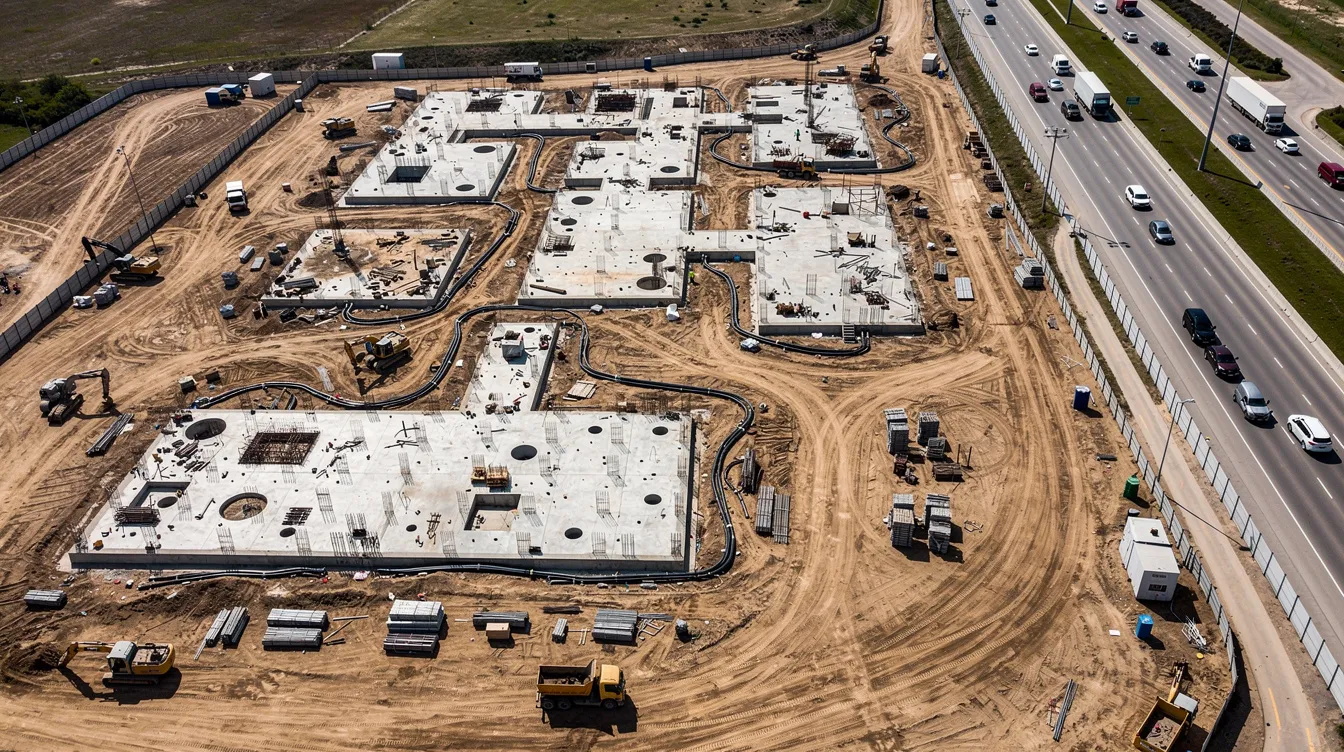
Mecklenburg County currently tracks 32 data center facilities and projects. Of those, 26 are operational, five are in active development, and one is inactive. The scale of what is coming dwarfs what exists: planned and in-pipeline projects account for approximately 2.3 gigawatts of power capacity, compared to roughly 90 MW currently operational. Earlier projects were often measured in the tens of megawatts, not gigawatt-scale demand. In Charlotte’s University City area, the PowerHouse Charlotte complex is underway and spans over one million square feet. Growth is booming and extends beyond Mecklenburg County. Across North Carolina, multiple data center projects are in various stages, from planning and permitting to active construction.
The opportunity is not limited to the buildings that house servers and support the digital services customers use every day. Data center demand pulls dozens of supporting scopes into the surge. Site work, utility infrastructure, electrical power upgrades, extensive mechanical systems (HVAC, UPS, chillers, generators), concrete and steel foundations, low-voltage systems, and security installations are all seeing heightened demand. General contractors, MEP subcontractors, and specialty trades are all affected. Early decisions about power infrastructure, specifically interconnection with Duke Energy, and site grading often determine whether a project moves forward or stalls.
For the broader Charlotte commercial construction market, the ripple effect is significant. Hyperscaler activity from companies such as Google is helping drive regional demand across North Carolina. Apple is another example of North Carolina data center investment influencing the broader market. Data centers are pulling skilled labor, equipment, and supplier capacity away from other sectors, including healthcare, retail, office buildouts, and renovation work. Contractors working across multiple project types must understand how data center demand accounts for shifting prices, extended lead times, and tighter subcontractor availability. North Carolina’s data center construction requires hundreds of construction jobs per project, and that demand draws from the same labor pool serving every other commercial sector in the region.
Craft labor competition has become one of the most critical challenges facing contractors across the Carolinas. Electricians, HVAC technicians, mechanical trades, and specialized installation workers are being pulled toward large data center builds. North Carolina’s “installation, maintenance, and repair” sector reported a shortage of approximately 8,300 workers as of December 2024, even as some construction and extraction trades showed modest surpluses. High wage rates attract workers from various construction sectors, intensifying the hiring challenge for non-data-center commercial work. Contractors report difficulty finding qualified workers across North Carolina, and the gap is widening as concurrent data center starts multiply.
Schedule compression is equally acute. Charlotte market contractors describe rapid mobilization as bringing crews and procurement demands forward faster, often requiring large teams of 100 to 200 or more workers to be deployed quickly, with tight sequencing around long-lead items such as generators, switchgear, and UPS systems. Delays in utility interconnection can ripple across an entire project timeline. Firms heavily weighted toward data center work report backlogs of 11.4 months or more, while companies with more diversified portfolios hover closer to 7.5 months. That difference matters for liquidity, workforce allocation, and risk exposure.
Material price inflation compounds the margin pressure. Nonferrous metals have risen approximately 62% year over year, and copper wire and cable are up roughly 22%. Combined with accelerated timelines and rising labor costs, these factors can squeeze margins if estimates don’t account for them. Detailed estimates and project management tools improve contracting transparency, helping protect margins while delivering projects under volatile conditions. Contractors who embed escalation clauses, early buyout options, and realistic risk allowances in their bids will navigate these conditions far more effectively than those relying on historical pricing assumptions.
Data center job sites are high-density, highly interdependent environments where safety risks escalate quickly. Elevated hazards include electrical dangers from high-voltage switchgear and redundancy systems, mechanical risks from cooling and backup power equipment, battery system hazards, chemicals in fire suppression systems, tight clearances with multiple trades crossing, and ongoing energized work before full commissioning. Safety culture is crucial in construction to protect liability, and on mission-critical projects the stakes are even higher.
Accelerated schedules increase the odds of fatigue, heat stress, and reduced supervision. In Charlotte’s humid climate, heat exposure is a serious concern during intensive work phases in equipment-dense environments. Trade overlap and site congestion create conditions where lapses in subcontractor coordination can have outsized consequences. Pre-task planning, strict PPE enforcement, and safety walkdowns become essential, not optional.
Best practices from large data center projects set the standard. On projects like Vantage Data Centers’ “Project Lighthouse,” OSHA requires all subcontractors to provide written safety and health programs, track incident and injury rates against Bureau of Labor Statistics baselines, and commit to continuously reducing injuries. Safety programs and compliance with OSHA guidelines are essential for contractors pursuing this work. North Carolina’s safety training includes compliance with NFPA standards, and contractors entering data center projects are preferred to have prior mission-critical experience. Contractors must meet both public codes and private specifications, which on data center work often exceed standard commercial requirements.
Investing in construction safety training resources and safety management education is not just a compliance exercise; it is a competitive differentiator in winning and executing data center contracts.

Not every data center opportunity is the right fit. Contractors should evaluate each prospect through a decision framework that weighs risk profile against growth potential:
Preconstruction and estimating preparation:
Operations and workforce readiness:
Safety and compliance capacity:
Business development strategy:
Contractors who have succeeded in data center work in the Charlotte region share common approaches. On greenfield projects, such as a 35,000-square-foot data center on 17 acres in Huntersville, NC, featuring multiple AC power rooms, UPS rooms, generators, and control rooms, success depended on early procurement planning, realistic baseline schedules, and rigorous integration of fabrication timelines into project logic.
On urban infill projects, such as a 10,000-square-foot data center fit-out in uptown Charlotte, execution required managing utility tie-ins to an occupied building, self-performing critical scopes (concrete, fire stopping, low-voltage security), and maintaining tight sequencing to minimize disruption to ongoing operations. These two delivery profiles illustrate distinct challenges that contractors must prepare for.
Workforce development investments have proven essential. An emerging specialized workforce supports future data center projects, and contractors committed to building internal training programs, rather than relying solely on market hiring, are better positioned to respond when opportunities arise. Workforce development and apprenticeships through programs like ABC Carolinas’ registered apprenticeship have shown measurable results: a 67% reduction in OSHA-recordable injuries, 90% fewer first-aid cases, and productivity increases of 10 to 24%.
Partnership approaches between general contractors and specialty trades also matter. On data center projects with N+1 or 2N redundancy requirements, MEP coordination must be seamless. Contractors who prequalify trade partners early, confirm capacity and safety records through reference interviews, and align on scheduling expectations are far more likely to deliver on time and within margin.
ABC Carolinas serves as a practical resource for contractors navigating data center opportunities across North Carolina and South Carolina. Merit shop philosophy emphasizes performance-based competition and supports ethical, profitable project delivery in construction. These principles help members win work in commercial contracting by encouraging transparency and accountability, qualities that data center owners actively seek in their contractor partners.
Charlotte has a strong commercial construction market, and ABC Carolinas members are positioned to lead in it. Networking events help commercial contractors connect with industry leaders through local engagement and identify potential project partners. ABC Carolinas also supports the Charlotte team through local peer groups, roundtables, and member involvement. Contractors and firms can join these local networking and learning opportunities. Charlotte hosts networking opportunities essential to contractor business growth, including peer groups, the Carolinas Gala, and member roundtables where data center market insights are shared directly.
North Carolina offers meaningful incentives for data center development. The North Carolina Competes Act provides tax exemptions for data centers, and North Carolina offers a sales tax exemption on electricity for qualifying facilities. State regulators are balancing grid reliability and clean energy goals, and data centers increasingly influence state energy planning and regulatory decisions. Contractors who understand these policy dynamics through government affairs and national efforts can better position themselves for the projects these incentives attract. That awareness also helps firms plan for effects on the local community and workforce needs.
Data center activity in the Charlotte region is concentrated along specific corridors and in counties with the infrastructure to support large-scale builds:
Beyond the Charlotte metro, the Triangle (Raleigh/Durham) is another intensive data center growth area in North Carolina, and the Charlotte-to-Greenville-to-Spartanburg corridor in South Carolina presents cross-state opportunity. Data center expansion is also shaping nearby schools and workforce planning needs in fast-growth corridors. Contractors operating across state lines should track shifting zoning, regulatory, and utility conditions in both North Carolina and South Carolina. Local contractors in Charlotte benefit from established relationships with plan reviewers and inspectors, and Mecklenburg County Code Enforcement processes permitting for commercial projects.
Site selection increasingly hinges on access to high-capacity power, grid interconnection speed, water availability, and environmental permitting. Charlotte’s moratorium on new data center approvals (through November 5, 2026) creates timing risk for early-stage projects, while exempt projects with approved or complete applications continue to progress. Regulatory timelines can directly affect project schedules in North Carolina, and contractors should factor policy risk into project evaluation.
Start with supporting scopes: site work, concrete, structural steel, or low-voltage systems where the barrier to entry is lower. Build your safety track record and document it. Data center projects require compliance with the North Carolina Building Code, and demonstrating code compliance expertise on commercial work translates directly. Interviews with references can reveal a contractor’s reliability and performance, so ensure your project history is well documented and verifiable. For example, a smaller contractor might begin with site utilities or low-voltage installation before bidding on more specialized data center scopes.
At minimum, supervisors should have OSHA 30-hour training, and the project should include site-specific safety plans and documented incident tracking. Many owners require written safety and health programs with quarterly metrics benchmarked against BLS data. North Carolina offers safety programs for commercial contractors that align with these requirements. ABC Carolinas’ safety education and STEP program provide frameworks that meet or exceed owner expectations.
Build in escalation factors for nonferrous metals (up ~62% YOY), copper wire and cable (up ~22%), and long-lead mechanical equipment. Use current wage data rather than historical averages; high wage rates in the data center sector are pulling workers from other construction sectors. A contractor’s financial stability is crucial to avoid delays, so confirm your pricing supports cash flow through extended procurement cycles.
Prequalify subcontractors for mission-critical experience, verify their backlog capacity (firms over 11 months of backlog face higher schedule risk), and align on procurement timelines early. Commercial construction follows distinct building codes compared to residential projects, and data center specifications add additional requirements. Strong partnerships depend on shared understanding of these standards.
ABC Carolinas offers workforce development and apprenticeships, construction safety training resources, networking events, and advocacy support through government affairs. These resources equip members to compete on performance, build qualified crews, and understand the policy landscape shaping data center development across the region.
The data center opportunity in the Carolinas is real, measurable, and accelerating. But it rewards disciplined preparation, not volume chasing. Contractors who tighten preconstruction planning, invest in workforce pipelines, strengthen safety programs, and evaluate each opportunity through a clear risk framework will capture sustainable growth.
Your concrete next step: connect with ABC Carolinas this quarter. Explore workforce development and apprenticeships to build the craft pipeline data center work demands. Register for safety management education to prepare field leadership for mission-critical jobsite requirements. And stay engaged with government affairs and national efforts as permitting, zoning, and energy policy continue to shape the data center landscape across North Carolina and South Carolina.
Merit shop contractors who commit to performance, safety, and workforce excellence will lead this market. The opportunity is here. The question is whether your firm is ready to deliver.


