


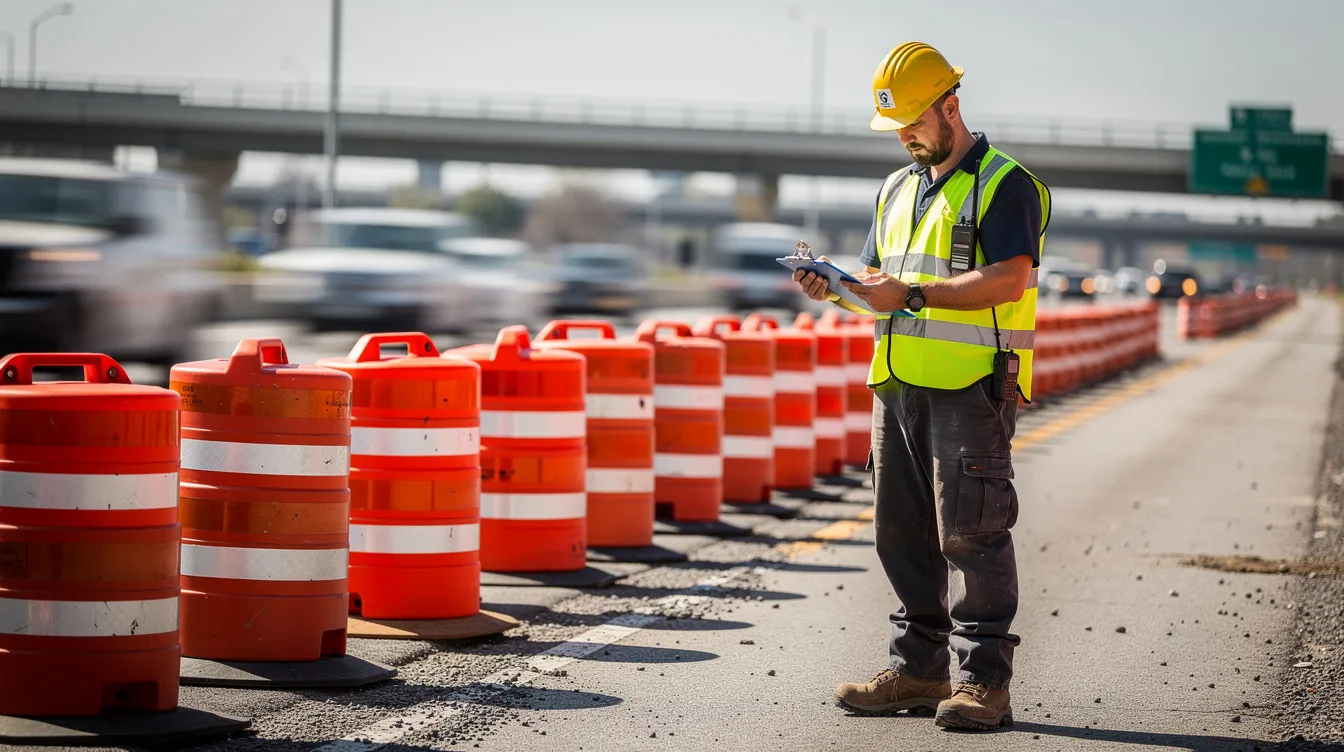
Every crew working near moving traffic on an I-85 interchange, a Charlotte arterial, or a two-lane utility cut in the Upstate faces one core question before the first cone goes down: where does the protected space begin, and where does it end? Understanding what a safety zone in roadway construction is is the first step to answering that question. In work-zone terms, the safety zone is the protected space created when public traffic, construction vehicles, and on-foot workers are deliberately separated, and that separation is maintained throughout the shift.
A safety zone is not the entire work zone, and it is not the plan itself. In roadway construction, it is the protected area created when temporary traffic control and internal traffic control are laid out, communicated, and maintained well enough to keep workers separated from moving vehicles and equipment.
Simply put, a safety zone is the area where workers perform tasks with reduced exposure to moving traffic and equipment. It is not a universal legal term with one stand-alone federal definition for every construction setting. In roadway work, it is best understood through OSHA, FHWA, and NIOSH guidance: a protected space created by planning, traffic control devices, equipment-routing decisions, and active supervision.
That distinction matters on Carolinas jobs. On a lane closure along I-77 near Charlotte, the work zone includes the full area affected by the operation, from advance warning through the downstream end. The temporary traffic control plan addresses how motorists are guided around or through that space. The internal traffic control plan addresses how dump trucks, pavers, laborers, and spotters move inside it. The safety zone is the resulting protected work area where those controls come together well enough to separate people from vehicle paths.
In practice, that means crews define the zone through layout decisions, channelizing devices, barriers where used, designated access points, pedestrian paths, and clear rules about who can enter the space and how. Whether the project is interstate paving near Spartanburg, a Triangle utility relocation, or downtown Greenville streetscape work, the same basic question applies: can the crew point to the protected area and explain how it is being kept protected?
OSHA’s highway work-zone overview highlights struck-by, falls, electrical, and caught-between hazards as common risks. NIOSH adds the sharper point for construction employers: struck-by injuries are the leading cause of nonfatal injuries and the second most common cause of fatalities among construction workers.
On roadway and utility projects in North and South Carolina, familiar failure modes include:
These are life-safety events first, but they are also business events. A compromised safety zone can mean shutdowns, damaged owner confidence, lost production, incident reviews, insurance pressure, and delayed schedules. On public work, even a near miss can trigger additional scrutiny and require the crew to reset the operation before production resumes.
That is why the safety zone is more than a field concept. It is a management control. FHWA policy emphasizes systematic attention to the safety and mobility impacts of work zones, including temporary traffic control devices and positive protection in the circumstances addressed by federal requirements and agency guidance. NIOSH specifically points contractors toward internal traffic control planning to reduce worker exposure inside roadway work zones.
These terms often blur together in conversation, but they solve different problems.
| Term | What It Covers | Primary Function |
|---|---|---|
| Work zone | The full area of roadway construction, maintenance, or utility activity, including approach and termination areas | Defines the total footprint of the operation |
| Temporary traffic control plan | The signs, tapers, channelizing devices, detours, flagging, and related measures used to manage public traffic | Guides motorists safely around or through the work area |
| Internal traffic control plan | The plan for construction vehicle paths, backing areas, staging, and worker walk paths inside the work zone | Separates equipment movement from workers on foot |
| Safety zone | The protected work area created when those controls are implemented effectively | Provides the space where crews can work with reduced exposure |
A useful field test is simple: if the superintendent or foreman cannot walk the site and identify the protected work area, the safety zone is not clearly established yet.
When contractors ask what is a safety zone on an active corridor job, the answer often starts inside the closure, not outside it. NIOSH’s bulletin on internal traffic control plans explains why: many struck-by incidents happen when construction vehicles and workers on foot share the same space without a defined movement system.
An internal traffic control plan separates work vehicles from workers by establishing how equipment moves, where backing is allowed, where materials are staged, and where workers should walk. It turns assumed separation into planned separation.
Core elements usually include:
Consider a night utility repair near Fayetteville. The crew uses one truck entry point at the downstream end, keeps pedestrian movement to the shoulder side, limits reversing to one controlled location, and reviews the map during the pre-task briefing. That setup does not eliminate risk, but it gives the crew a defined interior safety zone instead of an improvised one.
For contractors, the management point is straightforward: if the plan for your own trucks and equipment is vague, the safety zone is already weak before you consider public traffic.
Temporary traffic control forms the safety zone’s outer edge. It is how the site communicates with the traveling public and creates visible separation between traffic and work activity.
Depending on the operation, core elements can include:
FHWA policy for Federal-aid highway projects addresses temporary traffic control devices, positive protection devices, and, in certain cases, uniformed law enforcement officers as part of broader work-zone safety and mobility planning. The key editorial point here is not to overstate that into a one-size-fits-all rule. Barrier use, positive protection, law-enforcement support, and approval processes depend on project conditions, agency requirements, and contract documents.
For contractors in the Carolinas, that means treating the external envelope as an engineering and owner-coordination question, not a habit. High-speed nighttime paving on an interstate is a different exposure than a short-duration shoulder task on a local route. The safety zone still matters in both cases, but the controls that create it may differ substantially.
All work near moving traffic needs planning. The level of formality depends on the roadway, the operation, and the owner’s requirements.
Conditions that often call for a more detailed temporary traffic control setup and a documented internal traffic control plan include:
By contrast, a short inspection or minor shoulder activity on a lower-speed local road may involve a simpler setup. The key point is this: the supplied evidence does not support the claim that every job requires a traffic management plan approved by local transport officers before work begins. Instead, contractors should review the governing owner specifications, agency manuals, permit conditions, and contract documents to determine what plans, approvals, and credentials that specific job requires.
That project-by-project review is the most reliable decision tool. It also keeps field teams from treating custom owner requirements as universal law.
Carolinas contractors need to align work-zone operations with both general safety guidance and owner-specific requirements.
North Carolina: NC DOL’s highway work-zone safety page defines a work zone as an area of a highway with construction, maintenance, or utility activity. It also says workers exposed to struck-by hazards should wear high-visibility clothing and be trained on the use and meaning of temporary traffic control devices.
South Carolina: SCDOT’s work-zone traffic control page states that its Work Zone Safety and Mobility Rule applies to state and local governments receiving Federal-aid highway funding. The same page says SCDOT requires work-zone traffic-control training for certain employees whose duties include implementing and maintaining a transportation management plan.
Beyond those baseline points, contractors should avoid assumptions. Specific approval paths, training expectations, qualified-person requirements, and device standards can vary by agency and contract. If the bid documents or owner manuals impose additional certification or supervisor requirements, handle them as project-specific compliance items rather than generalized companywide shorthand.
That is especially important for executives overseeing work across multiple owners, municipalities, and DOT environments in both states.
To keep this article distinct from broader work-zone coverage, use this five-question field test before each shift. If you answer no to any question, the safety zone needs work before production starts.
This test gives foremen and superintendents a simple decision sequence they can use on highway resurfacing, utility relocations, and arterial corridor work across Charlotte, the Triangle, and Upstate South Carolina.
For many contractors, the best next step is turning this list into a one-page field form tied to pre-task planning and daily supervision.
For ABC Carolinas members, the practical next step is training and system discipline. ABC Carolinas’ Safety & Management Education program highlights safety training, STEP participation, and peer learning designed to help contractors build safer projects across North and South Carolina.
The association’s safety programming matters because a safety zone only works when the company’s broader safety system does. Daily planning, supervision, communication, and post-job learning all matter. Contractors looking to strengthen that system can also compare their broader processes against ABC Carolinas’ safety management system guide.
If your crews are working near moving traffic this season, a useful executive step is to review one active corridor or utility project and ask a simple question: could every foreman on that job clearly explain the safety zone, the vehicle paths, and the stop-work trigger if the zone is compromised? If not, that’s where to start.
Below are answers to common questions about this topic.
No. The work zone is the full area affected by the operation. The safety zone is the protected space inside that broader area where workers are intended to operate with reduced exposure to public traffic and construction vehicles.
Not necessarily in the same level of detail. The evidence provided supports using internal traffic control planning as a key safety measure, especially when equipment movement and worker exposure are significant. Whether a formal written document is required depends on the owner, contract, and job conditions.
Usually, it is loss of separation. That can happen when devices drift out of place, a truck route changes without communication, a spotter is missing, or the crew starts walking through equipment space because production pressure overrides the plan.
Responsibility may be shared across the owner, traffic-control designer, superintendent, and field supervisors, depending on the project. Operationally, though, the crew leadership on site needs to identify and maintain it each shift.
ABC Carolinas members can start with Safety & Management Education for training and STEP-related safety support. For broader work-zone context, readers can also review ABC Carolinas’ related article on work zone safety on Carolinas projects.


