


Rigger training that stops at basic sling selection and static load charts is no longer sufficient for the lifts happening across the Carolinas’ commercial construction today. As cranes grow more connected, lift planning moves into 3D software, and OSHA evaluation requirements under 29 CFR 1926.1427 tighten employer obligations, the gap between traditional classroom instruction and actual jobsite demands is widening. Contractors who close that gap protect crews, reduce project delays, and strengthen their competitive position on complex bids.
If your crews show up to Charlotte high-rise steel erection or Triangle data center mechanical installs with classroom certificates that don’t reflect the equipment, site constraints, or digital workflows they will encounter, you are carrying risk that documentation alone will not resolve. Most rigger training programs prepare workers for various industrial environments, including construction and manufacturing, yet they focus on compliance minimums and miss the technology integration, scenario-based hazard recognition, and structured employer evaluation that modern commercial lifts require.
Rigger training programs require formal instruction and practical evaluation, but real competency takes more. Programs that blend classroom instruction with hands-on experience and integrate digital lift-planning tools, telematics interpretation, and jobsite-specific scenarios give contractors a workforce that can perform under the conditions they actually face. Training assessments through written exams, practical skills demonstrations, and related documentation are required, and the most effective programs tie those assessments directly to the equipment configurations and site realities your crews will encounter.
ABC Carolinas connects merit shop contractors across North Carolina and South Carolina with the Safety Management Education programs and workforce development resources needed to build that competency at scale. The goal is practical: help contractors achieve OSHA 1926.1427 compliance faster, with less administrative burden, and without the complexity of piecing together multiple training sources or relying on inconsistent on-the-job learning.
The difference between traditional rigger training and what today’s job sites demand is not a matter of degree; it is a difference in kind. Here is what makes modern rigger training distinct:
Traditional training forces contractors to supplement basic courses with on-the-job learning that is inconsistent, difficult to document, and potentially dangerous. Modern rigger training replaces that patchwork approach with a structured competency development process.
Moving crews from compliance to genuine field competency doesn’t require complexity. The process is structured around three progressive steps.
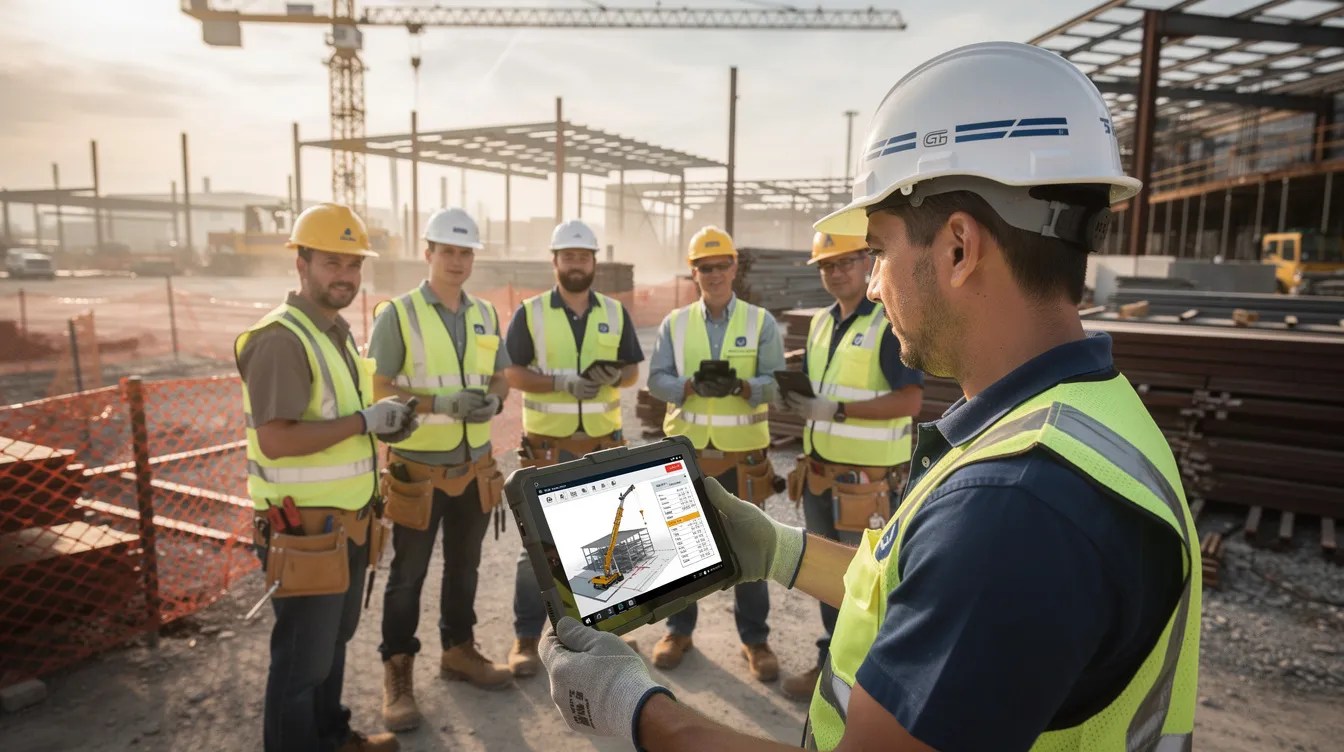
Participants develop core skills in load management and rigging equipment inspection, but they learn those skills using the same digital tools they will encounter on commercial job sites. Load calculations, sling angles, center-of-gravity determinations, and rigging hardware selection are taught with modern planning software alongside traditional methods. Training generally emphasizes safe practices for attaching and securing loads, and digital lift planning tools make those practices repeatable and verifiable. Hands-on crane training is available at various facilities, and programs can be conducted at your facility, using actual site conditions as the learning environment.
Real-world lift situations form the core of this phase. Crews analyze site data, weather monitoring inputs, and equipment telemetry to practice the decision-making they will face during complex lifts. Rigger training covers the proper use of personal protective equipment and safety protocols, and crews also rehearse different lifting tasks under changing site conditions; scenario-based instruction extends that coverage to changing conditions: what happens when wind exceeds limits mid-lift, when a trade partner enters an exclusion zone, or when the load path encounters an unexpected obstruction. Safety training includes emergency procedures for crane operations, and scenarios replicate those emergencies so responses become reflexive. Operators practice escalation communication protocols, including when to stop a lift, until they become second nature.
OSHA mandates safety training for crane operators under standard 1926.1427, and the same regulation requires employers to evaluate, document, and maintain records of competency assessments. OSHA regulations require a “qualified rigger” for lifting operations in fall zones, and employers must demonstrate that qualification through documented evaluation. Modern training builds structured employer evaluation processes that include the operator’s name, evaluator’s name, date, equipment make and model, and the specific configuration used during the assessment. Retraining triggers are established for performance deficiencies, scope changes, or periodic refreshers. Nationally recognized certifications typically require renewal every 3 to 5 years, and the documentation system tracks those timelines automatically.
Most alternatives focus on delivering content. The rigger training that actually reduces risk focuses on outcomes: fewer incidents, fewer delays, and stronger client confidence.
If traditional approaches offer checklists, modern training offers clarity. If generic programs require extensive supplemental OJT, modern programs provide structured guidance that translates directly to field readiness.
The evidence for updated training is measurable and specific. One national heavy lift contractor overhauled its training using a digital platform and reduced recertification preparation costs by 87% while increasing safety compliance training completion from 75% to 99%. Standardized digital delivery minimized site downtime and achieved high adoption rates even among veteran, experienced crane operators.
In lift planning, contractors using 3D digital planning tools have built thousands of lift plans that account for tower crane placement, ingress and egress, obstruction checks, and radius interference with other trades. The result is fewer surprises on lift day, fewer mobilization changes, and more accurate bids.
Rigging practices must follow industry standards to be legally compliant, and incident data reinforces why. In specialized rigging sectors, reported incident rates run approximately 1 per 2,083 to 1 per 2,500 jobs, confirming that rigging incidents still occur at meaningful frequency even in industries with established standards. Traditional training alone has not eliminated these events, pointing to the need for scenario-based, technology-integrated instruction that addresses the root causes: hazard recognition failures, communication breakdowns, and inadequate pre-lift planning.
ABC Carolinas members operating across multiple state jurisdictions benefit from comprehensive safety programs that connect training, documentation, and continuous improvement. The Safety Resources Center provides practical tools and reference material to help contractors maintain the accuracy and consistency their programs require. As specialty trade growth reshapes training needs, contractors who invest in competent crews and open competition are better positioned than those relying on outdated habits.
Updated rigger training is built for growth-focused contractors who recognize that the bar for lift competency is rising.
Contractors who want measurable risk reduction, stronger bid competitiveness, and the ability to help crews perform at a higher standard on every lift will find updated rigger training the most direct path to those results.
ABC Carolinas provides a structured approach to rigger training development that scales with contractor needs.
Foundational programs covering OSHA 1926.1427 requirements and essential rigging competencies are the starting point. These programs address load calculations, equipment inspection, sling selection, signal person coordination, and the administration of employer evaluation documentation. The subject matter covers what every contractor needs to learn and provide to crews entering commercial construction rigging work. Programs include both a written test and practical test components to ensure competency is determined through verified assessment, not assumption.
Comprehensive training designed for contractors scaling operations across Charlotte, the Triangle, or Upstate South Carolina integrates scenario-based learning, digital lift planning tools, and competency assessment systems. These programs go beyond fundamentals to address BIM coordination, telematics interpretation, critical lift planning (lifts exceeding 75% of rated capacity, multi-crane lifts, or lifts near power lines), and structured communication protocols. The program model is based on how experienced contractors actually plan and execute complex lifts, not on generic instruction disconnected from field conditions.
Tailored programs for ABC Carolinas members address specific jobsite requirements, equipment configurations, and regional hazards. These include priority access to safety resources, peer networking with contractors facing similar challenges, and ongoing regulatory updates through ABC Carolinas News. Custom solutions ensure that training content matches the controls, equipment, and site conditions your crews will encounter, whether that means urban Charlotte lifts, rural South Carolina utility work, or industrial manufacturing projects along the I-85 corridor.
Below are answers to common questions about this topic.
Most contractors who implement structured rigger training with scenario-based learning and documented evaluation processes see measurable improvements within 60 to 90 days. Initial gains typically appear in pre-lift planning quality, communication protocol consistency, and documentation completeness. Longer-term improvements in incident reduction and project timeline performance build as competency evaluation systems mature and retraining cycles take effect. The number of lifts completed without delay or incident becomes a trackable performance metric.
No. Programs are designed for field professionals with varying levels of technical experience. The instruction starts with fundamentals and introduces digital tools progressively, building confidence through use rather than requiring prior software expertise. Crews that have never used lift planning software or interpreted telematics data can develop working proficiency during training. The goal is to ensure every rigger can use the tools and information available on modern job sites, not to turn field crews into software specialists.
Modern rigger training complements and strengthens existing OSHA compliance efforts, not replace them. The competency evaluation framework aligns with 29 CFR 1926.1427 requirements, and the documentation system integrates with existing safety management platforms. Contractors with established license and certification tracking, toolbox talk programs, or incident reporting systems can layer rigger competency evaluation into those workflows. The training supports continuous improvement initiatives by providing the data and assessment structure needed to identify trends, trigger retraining, and measure program effectiveness over time.
Every complex lift on a Carolinas commercial jobsite is a test of your crews’ competency, your documentation systems, and your risk controls. Contractors that keep relying on outdated training approaches face growing exposure as equipment advances, OSHA enforcement tightens, and project owners demand verifiable qualifications from every trade partner on site.
The next step is practical. Review your current rigger evaluation records against the specific requirements of OSHA 1926.1427. Identify whether your documentation includes equipment configuration, evaluator credentials, and assessment dates for every rigger performing lifts. Audit whether your pre-lift planning process uses the digital tools and communication protocols that complex commercial schedules demand.
Then register your crews for Safety Management Education through ABC Carolinas to close the gaps. Whether you need foundational rigging competency for new hires entering the field in September, November, or February, or advanced scenario-based training for experienced crews working Charlotte high-rises or Triangle data centers, ABC Carolinas provides the training, resources, and contractor network to get your workforce field-ready.
No long-term obligations. Immediate practical improvements. And the regional connections that help merit shop contractors compete and win across North Carolina and South Carolina.


