


Artificial intelligence is transforming how construction projects are budgeted and executed, and the pressure to adopt it is no longer theoretical. For commercial contractors across North Carolina and South Carolina, compressed bid windows, growing project complexity, and a stretched workforce are converging into a single operational question: can your estimating process keep pace with the work in front of you?
This article breaks down where AI in construction estimating delivers real-time savings, what it takes to protect estimating accuracy, and how Carolinas firms can adopt smart tools without losing the estimator judgment that wins profitable work.
The construction industry is facing schedules that would have been unthinkable five years ago. Amazon’s “Titus” initiative aims to deliver data center infrastructure in under 35 weeks. Meta’s Hyperion and Oracle/OpenAI’s Project Jupiter are imposing similarly aggressive schedules. These hyperscale projects have created an estimated 4.7 million temporary construction jobs nationally, while 92% of firms report they are struggling to hire. AI is helping bridge construction labor shortages through automation, making faster estimating workflows essential rather than optional.
In North Carolina alone, tracking services identify at least 27 data center projects in various stages of development. ABC’s national Construction Backlog Indicator shows contractors handling data center work carry 11.4 months of backlog, compared to 7.5 months for those without. Yet overall backlog is softening, which means competition for new awards is intensifying. Contractors who respond fastest with accurate estimates are positioned to win.
Here is the reality: 75% of construction companies still lack AI adoption plans. For merit shop contractors in the Carolinas, that gap is an opening. Faster estimating strengthens bid volume, improves client communication, and lets firms compete for more bids without proportionally expanding headcount. AI can generate estimates in 24 to 72 hours, a cycle that traditional methods often stretch across weeks.
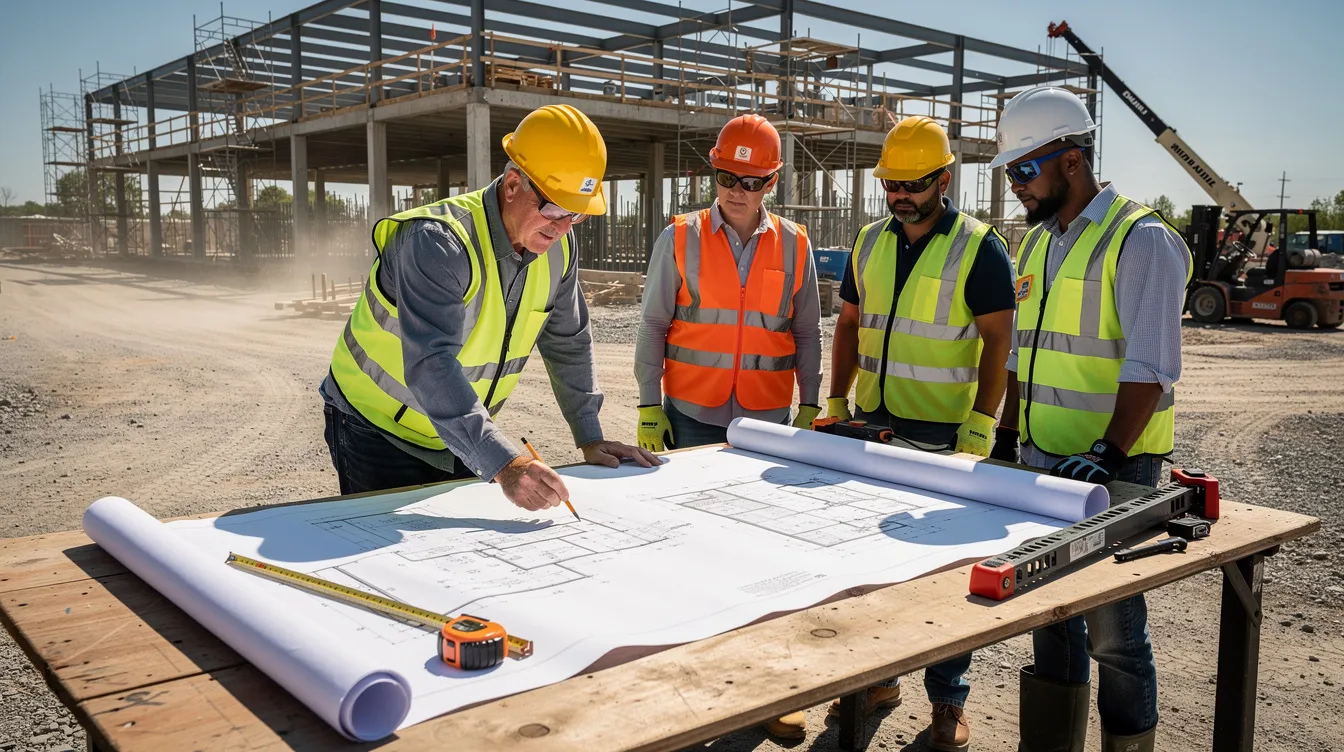
Not every step in the estimating process benefits equally from automation. Understanding where AI delivers and where it falls short is the difference between a productivity gain and an expensive mistake.
AI can reduce estimating time by up to 50%. Those gains come from the software’s automation capabilities across quantity takeoffs, plan review, proposal drafting, and historical data retrieval. AI automates repetitive tasks and processes massive construction estimating datasets, freeing estimators to focus on pricing strategy, risk analysis, and scope negotiations. In some scenarios, AI can generate estimates in as little as 30 seconds for standardized assemblies. Automation can increase bidding capacity by 3x without extra overhead, meaning the same estimating teams can cover significantly more work.
AI tools can automate quantity takeoffs from 3D models and 2D plans alike, extracting quantities of specific elements such as doors, windows, fixtures, and hardware. AI can analyze blueprints and BIM files in minutes rather than weeks. AI supports decision-making by automating routine tasks like plan sorting, scale detection, and material counting, so estimators can focus on higher-value work.
Steps that still require estimator judgment:
The most immediate value of AI-powered estimating shows up in three workflows:
Quantity extraction from construction drawings. Computer vision models detect and count elements across plan sheets, producing structured tables with page references and confidence scores. AI can flag discrepancies in quantity data for accuracy, catching missed quantities before they become cost overruns. AI can enhance data analysis capabilities for better pricing accuracy by comparing extracted quantities against historical benchmarks.
Scope comparison and bid leveling. AI analyzes historical data to predict project costs by comparing current scope documents against past projects of similar size and type. AI centralizes past project data to refine and improve future estimates, creating a living database of unit costs, assemblies, and trade breakdowns. Predictive analytics allow teams to identify potential cost overruns early, before a bid goes out the door. AI helps project managers streamline procurement and scheduling by surfacing scope gaps between revisions.
Proposal drafting and subcontractor RFQ prep. AI-driven estimating tools can generate draft proposals from extracted material lists, structured BOMs, and historical language. These drafts save significant time on manual data entry and reduce the manual effort of retyping information across systems, though estimators must review every output before sending.
Drawing quality determines AI performance. High-resolution PDFs (minimum 200 DPI, ideally 300+) produce reliable detection. Some AI tools use “smart slicing” to split large drawings into overlapping tiles so small fixtures are not missed during the takeoff process.
Always verify auto-detected drawing scales manually. AI tools frequently misinterpret scale bars, especially with varied sheet sizes or inconsistent drafting standards. AI improves estimating accuracy by flagging anomalies, but the estimator must confirm scale before quantities become cost estimates. Automated takeoffs can achieve 99%+ accuracy when input quality and scale verification are handled properly.
Connect your takeoff software directly into your construction estimating software to avoid data drift. Retyping quantities between spreadsheets and estimating platforms introduces errors. The most effective construction workflows house digital takeoffs, cost estimation, and RFQ generation in a single environment.

AI augments rather than replaces the estimator’s role in construction. AI cannot replace human judgment in estimating processes, particularly for risk assessment, scope interpretation, and vendor qualification. The goal is faster estimating with the same or better accuracy, not blind automation.
Human-in-the-loop review. Every AI output should be treated as a draft. Estimators approve all extracted quantities, unit costs, and scope inclusions before they enter a bid. Machine learning models minimize human calculation errors in construction estimating, but humans must validate the final output.
Estimator checklist. Standardize a checklist for each bid that covers:
Assumptions log. When AI fills in unit costs from historical data, document the source project, date, and conditions. AI improves estimating accuracy by analyzing historical data, but only when estimators can trace and verify those references. AI-driven accuracy reduces painful budget shortfalls, provided the assumptions behind each automated entry are visible and reviewable.
Peer review. A second estimator or project manager reviews every AI-assisted estimate before submission. This catches scope gaps, distortions from atypical conditions, and automated entries that do not match current market pricing.
High-quality input data is crucial to accurate AI estimates in construction. No estimating software, no matter how advanced, can overcome poor data.
| Data Element | Why It Matters | Common Problem |
|---|---|---|
| Historical job cost data | Feeds accurate cost predictions | Incomplete breakdowns, missing final costs |
| Cost codes and assemblies | Ensures consistency across multiple projects and multiple team members | Each estimator uses different categories |
| Change-order records | Captures real variable costs | Unlinked to original estimates |
| Subcontractor invoices | Reflects actual field conditions | Stored separately from project files |
Consider this: 88% of spreadsheets have 1% or more errors. If your historical project data lives primarily in spreadsheets with inconsistent naming, missing labor history, and poor change-order records, AI outputs will inherit those problems. AI accounts for fluctuating market conditions and local labor shortages only when the underlying data captures those variables.
Before launching an AI pilot, measure your dataset coverage. How many past projects match the scopes you are now bidding? A firm whose history is heavy in small retail but now wants to bid large data center builds will need to interpret AI results cautiously until the data catches up.
AI adoption is not plug-and-play and requires careful planning. Rushing deployment without controls creates new risks.
A phased rollout protects your investment and builds internal confidence.
Track three metrics monthly:
AI facilitates improved budgeting and cost control by continuously analyzing project data across completed jobs. Automated cost predictions improve risk assessment in construction by surfacing patterns that manual methods miss.

When evaluating estimating tools, compare both the speed and the control each platform offers:
The North Carolina data center corridor, spanning Charlotte, the Research Triangle, and the Piedmont, faces extraordinary schedule pressure. A single data hall from site mobilization to commissioning often takes 12 to 18 months, assuming permits and power are in place. Full campus builds span 3 to 7 years. Critical path items like major power transformers and medium voltage switchgear carry lead times of 8 to 18 months.
For contractors in Charlotte and the Triangle, faster estimating translates directly into the ability to respond to compressed bid windows. AI-driven project management improves resource allocation and scheduling efficiency, giving firms the flexibility to pursue project timelines that would overwhelm traditional estimating methods. AI supports proactive risk management by analyzing historical data and project conditions specific to these corridors.
In Upstate South Carolina, merit shop firms competing for industrial and manufacturing work need both speed and precision. Faster, more accurate estimates strengthen merit shop competitiveness by demonstrating professionalism without inflating project budgets. ABC Carolinas provides workforce development resources that help contractors build the operational maturity needed to adopt these technologies effectively.
AI is changing construction estimating into a strategic management function. Estimators are shifting toward strategic roles as AI automates manual tasks like counting and measuring, spending less time on them and more time on data analysis, risk evaluation, and pricing strategy.
AI democratizes estimating expertise by helping junior estimators produce accurate estimates with guidance from AI-powered tools, while senior estimators focus on complex projects and client relationships. ABC Carolinas’ apprenticeship and craft education programs provide a foundation for building these skills, from blueprint reading with AI annotations to cost code creation and data quality auditing.
Estimator peer groups and hands-on workshops are essential. Encourage estimating teams to share case studies of what AI picks up versus what it misses, building institutional knowledge that improves every future bid.
Faster estimating creates downstream pressure on subcontractor coordination. When you compress bid turnaround, subcontractors need clearer scope definitions and faster RFQ responses.
The time-consuming reality of traditional methods is that they cannot scale to meet the bid volume and project complexity now arriving in the Carolinas. AI-powered estimating is not a replacement for your estimators. It is the leverage that lets them do more, faster, with fewer errors. AI can save significant time across every phase of preconstruction, from reducing takeoff time to generating proposals.
Your next steps:
The firms that act now will set the pace for merit shop competition across the Carolinas. Start with one workflow, measure the results, and build from there.


