


Federal infrastructure dollars are flowing into North Carolina and South Carolina at a pace not seen in decades. For contractors pursuing that work, the Davis-Bacon Act is the single regulation most likely to determine whether a “won” project builds margin or destroys it. This guide covers what Carolina contractors need to verify, price, and document before submitting a bid on covered public construction projects in 2026.
The Davis-Bacon Act requires contractors on federal and many federally assisted public construction projects over $2,000 to pay workers the locally prevailing wage, consisting of a cash hourly rate plus fringe benefits, for their specific trade and geographic area.
Federal and federally assisted spending on infrastructure, military facilities, and public buildings is generating a growing pipeline of Davis-Bacon-covered construction projects across both states. From Fort Liberty and VA clinics to interstate improvements along I-85, I-77, and I-95, and from federally funded K-12 school projects to municipal water system upgrades, Carolinas contractors face more prevailing wage obligations in their bid queues than at any point in recent memory. Public bid compliance on these projects includes meeting local, state, and federal standards, and Davis-Bacon sits at the center of the federal layer.
Prevailing wage requirements affect labor cost assumptions for general contractors, specialty subcontractors, and suppliers who provide labor-installed scope. A miscalculated wage rate or a missed fringe obligation on a single trade can shift a competitive bid from profitable to underwater. Violations of the Davis-Bacon Act can lead to penalties including contract termination and financial liabilities. Contractors that focus on quality and efficiency, rather than merely undercutting labor costs to win bids, are best positioned to sustain growth on public work.
Political and regulatory debate around Davis-Bacon continues at the federal level, but this article stays focused on what the law requires now, how it affects your estimates, and what open-shop contractors in the Carolinas can do to compete on merit.
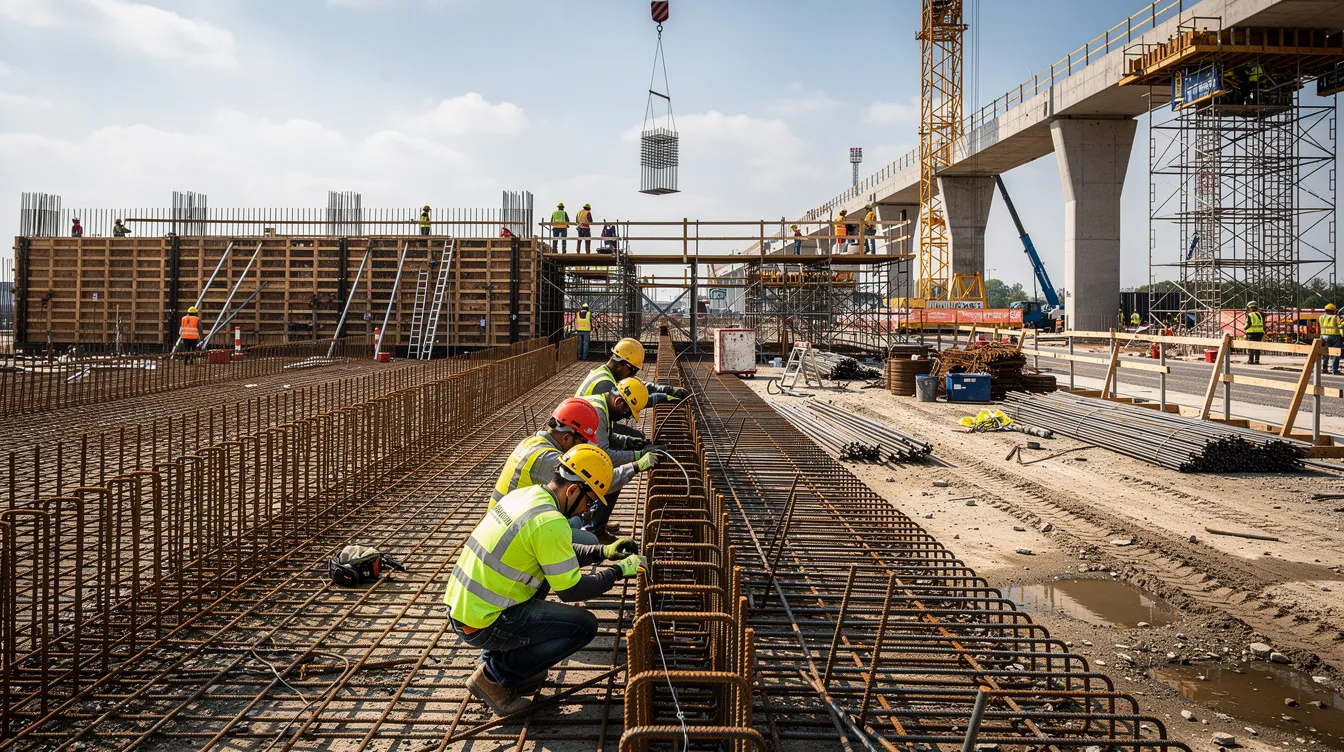
The Davis-Bacon Act, enacted in 1931 to protect local wage standards during the Great Depression, applies to contracts over $2,000 for construction, alteration, or repair of public works. The Wage and Hour Division of the U.S. Department of Labor administers the law. The Act also includes related acts, such as the Federal-Aid Highway Acts, which extend prevailing wage requirements to projects receiving federal financial assistance through grants, loans, or other funding mechanisms.
Under current rules, contractors and subcontractors must:
Retaliation against workers who report violations is strictly prohibited under the Davis-Bacon Act.
Common pressure points for open-shop Carolinas contractors include treating Davis-Bacon as relevant only to union firms, assuming private-market rates satisfy prevailing wage obligations, ignoring fringe requirements, or letting subs self-police without oversight. This article provides general guidance; contractors should confirm current regulations, wage determinations, and agency instructions for each specific project.
Wage determinations are the reference documents that drive every dollar of Davis-Bacon labor cost on a covered project. Getting the right one is the first step in compliant estimating.
A wage determination lists prevailing wages for labor categories, specifying the minimum basic hourly rate and fringe benefit amount for each trade classification in a given county or group of counties, for a particular construction type. Wage determinations are issued by the U.S. Department of Labor and published on SAM.gov.
Wage determinations are general or project-specific. General wage determinations do not expire and reflect local wages; they are updated periodically through modifications. Project wage determinations expire 180 days after issuance and are requested by agencies when no general determination fits. Most Carolinas contractors will encounter general wage determinations attached to bid documents. All wage determinations apply to federally funded construction projects.
Selecting the correct wage determination requires checking:
| Factor | What to Verify |
|---|---|
| Location | County or counties where work will be performed |
| Construction type | Building, highway, heavy, or residential |
| Funding source | Federal, federally assisted, or Related Act coverage |
| Modification number | Whether a newer version supersedes the one in the bid documents |
| Effective date | Whether the determination was current at bid opening or award |
Differences between counties and construction types are not trivial. In Durham County, the building wage determination (NC20260003) requires electricians to be paid $31.07/hr base plus fringe of 14.83% and $8.75/hr. In Craven, Jones, and Pamlico Counties under a residential determination (NC20260116), an electrician’s base is $15.00/hr with only $0.46/hr fringe. That gap can swing a labor budget by tens of thousands of dollars on a mid-size project.
Bidders should monitor addenda and contracting officer guidance for any revised wage determinations that supersede earlier versions, especially on procurements with long timelines.
Every scope element and crew position in an estimate must map to a Davis-Bacon classification on the applicable wage determination. Pricing a skilled trade at a general laborer rate, whether by accident or by habit from private work, is a direct path to back-wage liability.
To calculate a fully loaded Davis-Bacon wage for budgeting, combine the basic hourly rate and the fringe obligation, then layer in statutory burdens (FICA, FUTA, workers’ compensation, general liability), overtime assumptions, and overhead. In Catawba County, for example, an ironworker’s total prevailing rate is roughly $47.75/hr before any burden or overhead. A plumber in the same county runs $47.44/hr total. Those numbers set the floor, not the ceiling, for what the estimate must carry.
On a multi-county program, such as a series of municipal water projects stretching from Mecklenburg to Robeson County, the same classification may carry different prevailing wage rates in each county. Estimators who use a single blended rate across all locations expose the firm to underpayment in higher-rate counties.
Estimating checklist for Davis-Bacon labor:
This process connects directly to broader estimating discipline around protecting bids and margins when input prices are volatile.
Under the Davis-Bacon Act, the prevailing wage consists of two components: a basic hourly cash wage and a fringe benefit obligation. Open-shop contractors must decide how to meet the total: through cash, bona fide benefits (health insurance, retirement contributions, apprenticeship program costs, paid time off), or a combination.
Only the employer-funded portion of benefits counts toward the Davis-Bacon fringe credit. Benefits must be allocated to covered hours on the project, and “double counting” fringe toward both Davis-Bacon and other contractual obligations is not permitted. Voluntary bonuses or perks that do not meet federal criteria for bona fide fringe benefits cannot be credited.
Overtime pay regulations apply under related acts like the Contract Work Hours and Safety Standards Act (CWHSSA) for hours worked over 40 per week. A frequent mistake: adding the fringe amount to the cash wage and then computing overtime on the inflated total. Under Davis-Bacon, overtime is calculated on the basic rate of pay only; fringe credit does not inflate the overtime multiplier.
Coordination between estimating, HR, and payroll must happen before mobilization. The fringe treatment built into the bid needs to match what payroll systems produce on certified reports. Structured benefit programs and registered apprenticeship investments can help Carolinas contractors deliver competitive Davis-Bacon wages while building workforce pipelines and merit shop career paths.

Employers must submit weekly certified payroll reports detailing worker classifications and wages. Each report includes worker names or identifiers, classifications, daily and total hours, gross wages, deductions, net pay, and a signed statement of compliance. Electronic payrolls and signatures are accepted under current rules.
When a single employee works under multiple classifications or holds apprentice or trainee status, the certified payroll must accurately reflect those details. Employers must maintain payroll records for at least three years after project completion, including payroll data, fringe benefit documentation, and related subcontracts.
For Carolinas firms with crews moving between private commercial work and public projects in Charlotte, the Triangle, or the Upstate, timekeeping must capture hours by classification and by project. A laborer who spends Monday through Wednesday on a Davis-Bacon school renovation and Thursday through Friday on a private tenant fit-out needs two distinct time records for that week.
Audit readiness practices:
Getting worker classifications correct is the most complex part of Davis-Bacon compliance on multi-trade public construction projects. Contractors must classify workers accurately based on actual tasks performed on the job site, not on job titles or internal pay grades. A worker who operates equipment in the morning and performs general labor in the afternoon may need split-classification reporting.
Registered apprentices and trainees can work on Davis-Bacon projects at reduced wage rates, but only if enrolled in an approved program that meets ratio and supervision requirements. Apprenticeship compliance planning should be part of the pre-bid process, not an afterthought.
When a needed classification is missing from the wage determination, contractors must request a “conformance” addition through the contracting agency. Conformance cannot be used to set wages below existing prevailing wage rates for comparable classifications.
Carolinas-specific classification risk often surfaces on data center projects along the North Carolina corridor, where low-voltage and specialty electrical scopes may not map cleanly to standard wage determination categories. Similar issues arise on large industrial expansions near the I-85 corridor in South Carolina, where overlapping mechanical and electrical scopes can complicate classification. Early coordination among estimators, project managers, and compliance staff, with proactive written questions to the contracting officer or the contractor’s authorized representative, reduces the chance of a post-award classification finding.
Prime contractors on Davis-Bacon-covered public construction projects remain responsible for overall wage compliance, even when subcontractors perform most field labor. Employers must ensure subcontractors comply with labor standards on covered projects.
Davis-Bacon provisions, including wage determination attachments, certified payroll obligations, and audit cooperation requirements, must be flowed down to every subcontract through appropriate contract clauses. Common gaps include using standard private-work subcontracts that omit Davis-Bacon references, failing to attach the correct wage determination, or not requiring subs to submit certified payrolls on time.
Prequalification of subcontractors for public work should include review of their payroll systems, prior Davis-Bacon experience, and capacity to meet prevailing wage requirements. Practical monitoring strategies during the project include periodic spot checks of pay stubs versus wage determinations, requiring subs to identify all classifications used, and including contractual remedies for underpayment or non-compliance.
ABC Carolinas networking events and peer groups help primes and subs connect with partners who take compliance, ethics, and merit shop principles seriously on public work.
Non-compliant bids are typically denied without recourse. On awarded projects, compliance failures trigger back-wage orders, liquidated damages, or debarment. Here are the most frequent mistakes and how to prevent them:
| Mistake | Prevention |
|---|---|
| Classifying skilled trades as general laborers | Map every task to the correct wage determination classification before bid submission |
| Using the wrong wage determination (wrong county, wrong construction type, outdated modification) | Verify the determination number, county, construction category, and modification date against bid documents and SAM.gov |
| Miscalculating fringe benefits or crediting non-qualifying perks | Document all benefit plans; confirm only bona fide, employer-funded benefits are credited; separate fringe from overtime calculations |
| Incomplete certified payrolls or missing compliance statements | Use standardized templates; assign a responsible compliance contact; review every submission before filing |
| Failing to post wage determinations on the jobsite | Include posting in the mobilization checklist; verify during first-week site walk |
Schedule periodic Davis-Bacon refreshers through ABC Carolinas education programs. A two-hour training session for estimators and project admins costs far less than a single wage finding.
Preparation for public bids should start 30 to 45 days in advance for experienced firms. Bids must include non-collusion statements and insurance documentation in addition to Davis-Bacon wage compliance.

ABC Carolinas education programs, roundtables, and member briefings help contractors stay ahead of Davis-Bacon regulatory changes, wage determination practices, apprenticeship compliance updates, and workforce continuity risk. The association tracks federal and state regulatory developments that affect labor costs and jobsite requirements, keeping members informed through news, alerts, and events.
Workforce development and apprenticeship initiatives help members structure bona fide fringe benefits and training investments that support both Davis-Bacon compliance and local craft talent pipelines. Networking events and peer groups across the Charlotte market, the Triangle, coastal communities, and the Upstate give contractors a forum to share lessons learned on public work.
Contractors who routinely bid federal or public construction projects in the Carolinas and are not yet members should explore what ABC Carolinas offers: the resources to bid confidently, manage compliance risk, and uphold merit shop principles on every project.
These questions address practical issues that often arise beyond the core compliance topics covered above.
Whether Davis-Bacon applies on a mixed-funding project depends on the specific statute or funding program that provides the federal dollars. Contracting agencies will typically indicate coverage in the solicitation and contract clauses. Contractors should review bid documents for Davis-Bacon references on every project with any federal funding component and submit written clarification questions to the contracting officer when coverage is unclear. When there is a reasonable possibility of applicability, price labor at prevailing wage rates.
Contractors can employ workers across Davis-Bacon and non-Davis-Bacon projects, but must track hours separately by project and classification. Payroll systems, timecards, and supervisor training must support this level of detail. In high-growth regions like Charlotte and the Triangle, where crews frequently move between private commercial and public work, building project-level time tracking into daily operations is not optional; it is the baseline for audit defense.
If a revised wage determination is incorporated into the contract before award, contractors may be obligated to pay the higher rates even if the original bid used earlier figures. Bidders should monitor addenda, track effective dates and modification numbers, and plan for possible prevailing wage increases on procurements with long timelines.
Small subs can work on Davis-Bacon projects if the prime contractor provides clear expectations, templates, and training. Their basic payroll and recordkeeping practices need to be organized and accurate. Primes should provide orientation sessions and periodic check-ins. Membership in organizations like ABC Carolinas gives smaller firms access to shared compliance knowledge and education that makes the process manageable.
Firms new to Davis-Bacon work should begin preparations at least 60 to 90 days before bidding, allowing time to learn wage determinations, adjust payroll systems, update contract clauses, and train both office and field personnel. Integrate this planning with broader risk management: forecast labor needs, review workforce continuity exposure, and align Davis-Bacon compliance with overall strategies for protecting bids and margins on public work.


