For Carolina contractors, culture and safety are easiest to overestimate when the paperwork is complete but the field habits are inconsistent. Manuals, orientations, and training records still matter. But for executives walking active jobs in Charlotte, the Triangle, Upstate South Carolina, and along the I-85, I-77, and I-95 corridors, a simpler question matters more: can the project team show expectations in real work?
This article focuses on that decision. Instead of repeating broad safety-culture theory, it gives leaders a short executive field checklist, a simple scorecard, and a one-project pilot they can use to compare jobs and spot weak follow-through.
OSHA says management provides the leadership, vision, and resources needed for an effective safety and health program. OSHA also says workers should help establish, operate, evaluate, and improve that program. On multi-employer worksites, OSHA further emphasizes communication and coordination before work begins among host employers, contractors, and staffing agencies.
That framework matters because executives do not need to diagnose every field condition during a walk. They need to judge whether the operating system is visible. On a strong project, crews can explain the day’s plan, supervision is present during active work, concerns have a clear path upward, and overlapping trades know who owns shared risks.
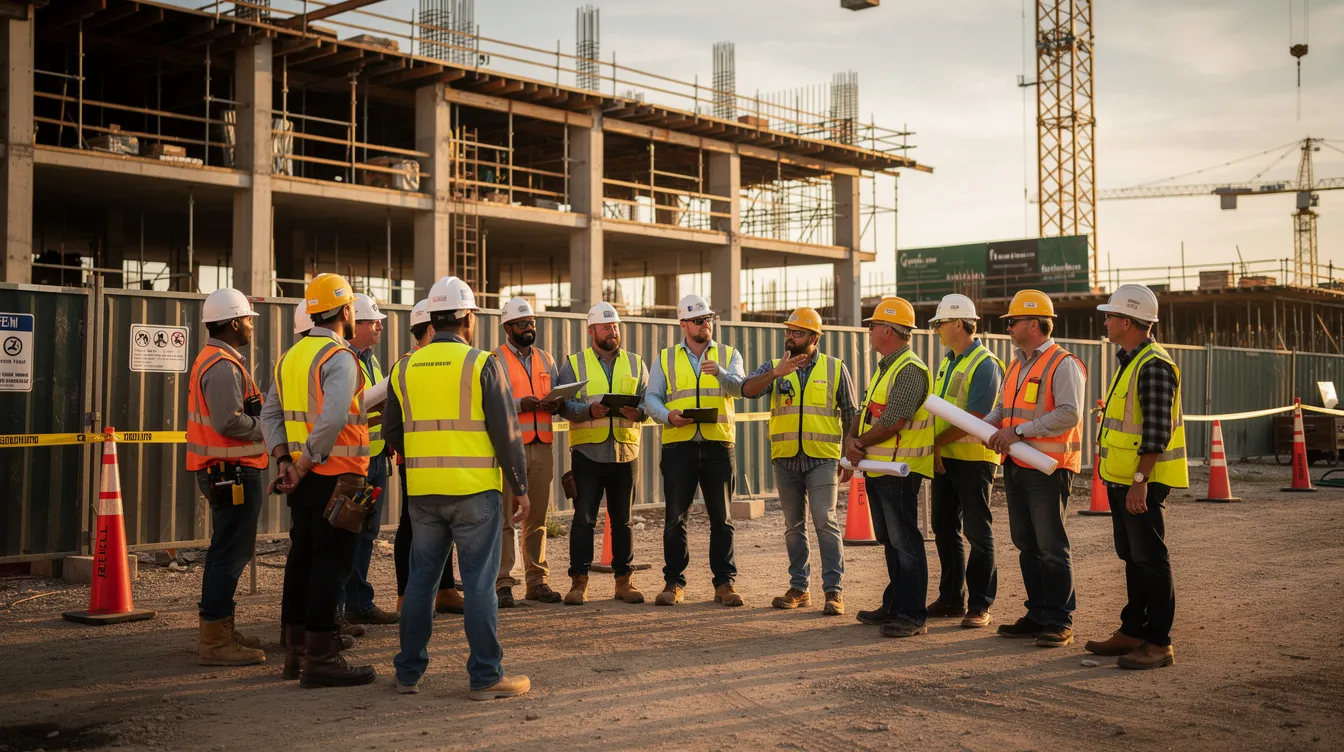
Use this during one monthly site walk. Mark each item yes, no, or unclear. The goal is not a perfect audit. It is a consistent way to compare projects.
If several items land in unclear, that is often the most important signal. Unclear answers usually mean expectations are not traveling reliably from leadership to supervision to crews.
| Executive Question | What a Strong Answer Looks Like |
|---|---|
| Do foremen lead task-specific planning before higher-risk work? | The crew can explain the day’s sequence, likely hazards, and basic controls without relying on a generic script. |
| Can workers explain how to raise a hazard or near-miss concern? | The reporting path is simple, familiar, and followed by visible response. |
| Are repeat issues being corrected or normalized? | Recurring problems have an owner, a correction path, and follow-up. |
| Are project managers, superintendents, and foremen aligned? | The production message and the safety message do not conflict in practice. |
| Is responsibility clear where trades overlap? | Teams can explain who owns shared hazards, access, housekeeping, and work boundaries before the task starts. |
After the walk, rate the project on a short leadership scorecard.
| Dimension | Green | Yellow | Red |
|---|---|---|---|
| Leadership Visibility | Leaders ask specific field questions and follow up. | Leadership presence is occasional or generic. | Leadership is largely invisible in field follow-through. |
| Worker Participation | Workers speak up during planning and follow-up. | Participation is uneven by crew or supervisor. | Workers are passive or unsure how to raise issues. |
| Pre-Task Planning Quality | Planning is specific to the work and understood by the crew. | Planning happens, but it feels routine or incomplete. | Planning is missing, generic, or disconnected from the task. |
| Corrective Follow-Up | Issues are assigned and visibly closed. | Some items close, others linger. | Problems repeat with little visible ownership. |
| Trade Coordination | Shared-risk handoffs are clear before work begins. | Some overlap is managed, some is improvised. | Trade conflicts and shared hazards are being discovered late. |
This tool works best as a pattern finder, not a blame tool. One red rating may reflect a rough day. Repeated yellow or red ratings across visits usually point to a supervision, planning, or coordination problem that leadership should address directly.
If your company wants to test this process, start small.
This is a proposed method, not a guaranteed result. Its value is that it keeps the conversation grounded in observable habits instead of broad statements about culture.
ABC Carolinas serves merit shop commercial construction companies across North and South Carolina. Contractors that identify weak points during executive walks can reinforce them with construction safety training resources, apprenticeship and workforce development programs, and broader guidance on construction safety management.
If your company already says culture and safety matter, the next step is practical: schedule one executive walk, use one checklist, score one active project honestly, and choose one routine to improve this month.