


Construction safety technology has moved beyond compliance checklists and post-incident reports. For commercial contractors across North and South Carolina, the shift from reactive recordkeeping to proactive risk detection is no longer theoretical. It is happening on active job sites from Charlotte to the Triangle to Upstate South Carolina, and the firms that operationalize it well will protect their crews, their schedules, and their margins.
The numbers make the case. In North Carolina, the construction fatality rate reached 7.9 per 100,000 workers for FY 2025, nearly double the overall industry average of approximately 4.1. The NC Department of Labor’s Special Emphasis Program for construction now targets counties where fatal incidents have clustered, covering roughly 40% of all construction fatalities statewide. For commercial construction firms, contractors, trade suppliers, and service providers working in North and South Carolina—from data centers along the I-85 corridor to high-rises in Charlotte and logistics warehouses in the Triangle—those statistics translate directly into regulatory scrutiny, insurance costs, project disruption, and workforce retention pressure.
Proactive safety is now a priority across the construction industry, and AI is driving the next response. Construction safety technology now means using AI-powered predictive analytics, wearable sensors, fleet and equipment monitoring, and real-time jobsite alerts to detect and reduce risk before an accident occurs. This briefing focuses on how Carolinas contractors can evaluate predictive safety tools, leading indicators, alert decision frameworks, emergency response integration, AI governance, training and buy-in, pilot rollout, measurement benchmarks, and legal and merit shop considerations. For firms running lean crews on large commercial projects, early warning is not a luxury. It is a practical way to protect workers, stay compliant, hold schedules, and control insurance costs.
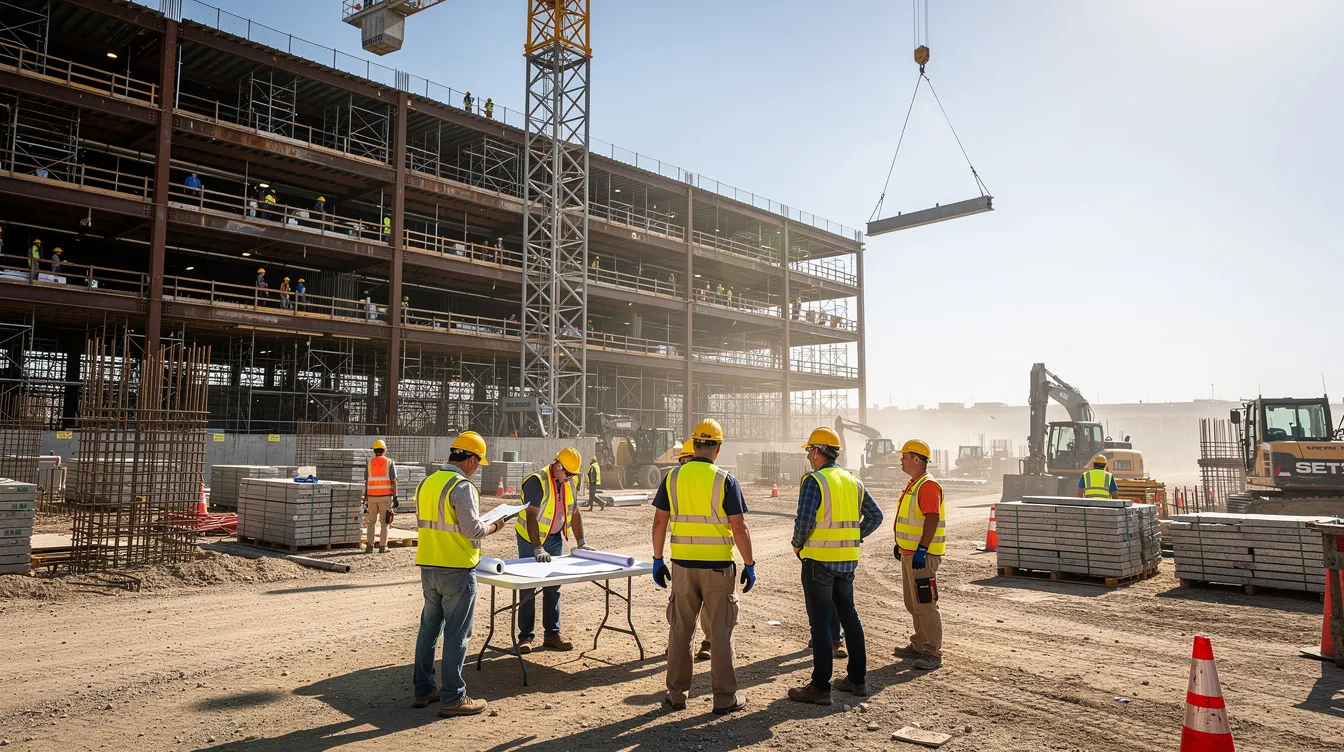
In practical field terms, predictive construction safety technology combines historical incident data, real-time sensor inputs, weather conditions, shift patterns, and crew observations through algorithms that surface risk signals before accidents occur. AI can predict future incidents using historical data, giving safety managers a forward view rather than a rearview mirror. AI systems can monitor compliance with safety protocols in real time, and a single platform can monitor 400 or more construction sites simultaneously.
The limits matter just as much. Predictive accuracy depends on input quality. If near-miss reports lack detail, if only certain trades submit observations, or if data sits in disconnected systems, the models produce noise instead of signal. AI integration enhances existing safety management systems, but it does not replace them. Dashboards without disciplined follow-through create false confidence.
When framed through ABC STEP principles, predictive tools strengthen all three pillars. They sharpen training by identifying recurring unsafe behaviors. They improve evaluation by tracking leading indicators across projects. They support policy by establishing data-driven thresholds for escalation. The key is to treat the technology as a decision-support layer, not autopilot.
Waiting for recordable incidents to drive safety decisions is like steering by the wake behind your boat. Leading indicators give superintendents, project managers, and safety directors the forward view they need. Here are the indicators worth tracking and the supervisor action each one triggers:
| Leading Indicator | What It Reveals | Supervisor Action |
|---|---|---|
| Near-miss reporting frequency | Emerging hazards before injury occurs | Trigger a toolbox talk with the involved crew; review task procedures |
| Inspection and audit completion rates | Whether scheduled safety checks are actually happening | Reassign personnel or adjust shift schedules to close gaps |
| Personal protective equipment compliance by shift and trade | Which crews or time windows have the most lapses | Increase spot checks for that trade; schedule corrective training |
| Pre-task planning quality | Whether crews are identifying specific hazards before critical tasks | Require hazard-specific sign-off before work begins in high-risk areas |
| Heat and fatigue signals from wearable sensors and logs | Physiological stress before a worker collapses | Rotate crew, enforce rest breaks, provide shade and hydration |
AI detects PPE violations in real time using computer vision, and digital reporting systems improve tracking of inspections and near-miss incidents. Smart wearables monitor worker vitals to prevent heat stress and fatigue, with recent field trials reaching approximately 95% accuracy in predicting heat stress using heart rate, heart rate variability, and oxygen saturation data. Continuous monitoring enables real-time alerts for unsafe conditions, giving supervisors actionable intelligence rather than after-the-fact paperwork.
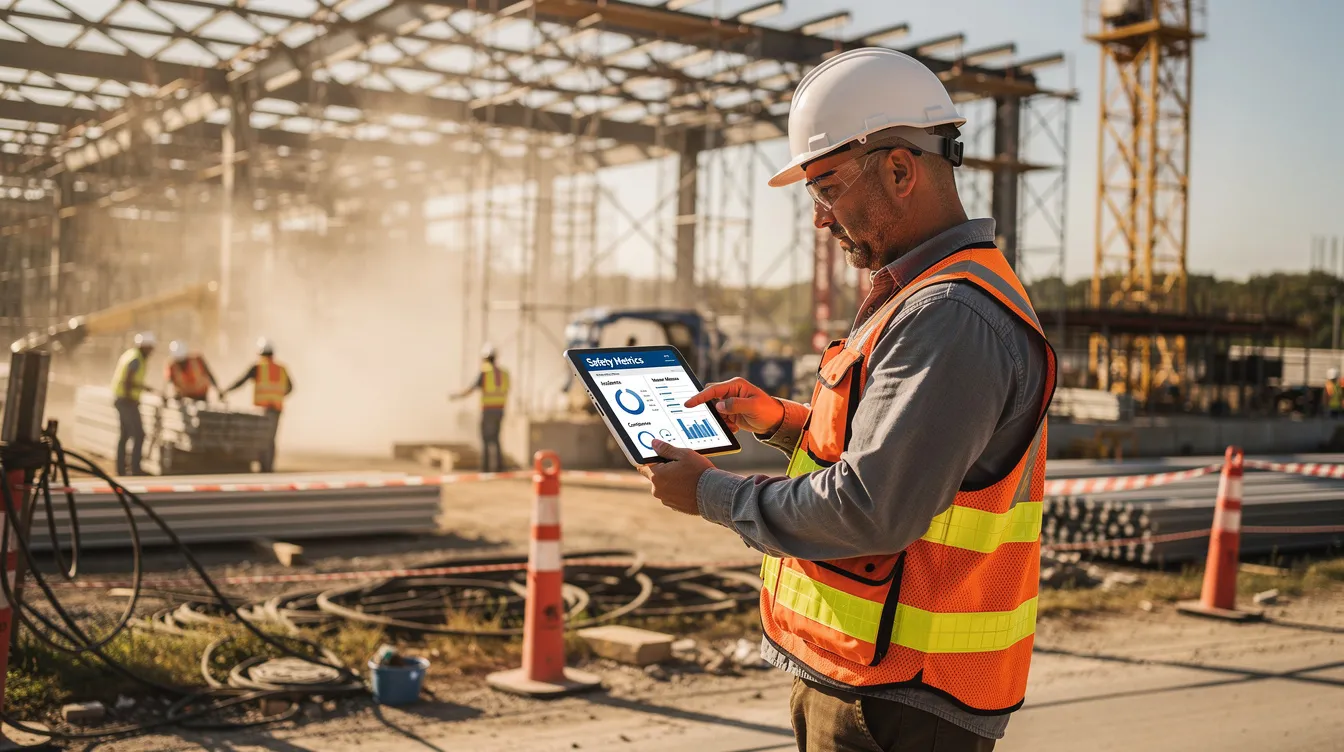
Data without a decision framework creates alert fatigue. The following five-step process turns predictive signals into field action:
Detect. Automated systems flag when a leading indicator crosses a threshold. AI-powered cameras analyze job site video feeds to detect safety violations, from missing guardrails on scaffolding to workers entering exclusion zones near a dump truck or heavy equipment. AI detects unsafe conditions 24/7 on construction sites, and proximity detection systems alert workers when entering dangerous zones around equipment. AI-powered cameras detect fall hazards and send instant alerts, covering dangers that intermittent human inspections would miss.
Verify. A competent person or supervisor conducts a walkthrough to confirm the alert. Not every flag requires escalation; some are false positives driven by camera angle, lighting, or context. Verification prevents overreaction and maintains crew trust.
Escalate. A named decision authority (foreman, superintendent, or safety director) determines the response: stop work, adjust the plan, reassign tasks, or increase supervision. Escalation thresholds should be documented. For example, three PPE non-compliance events in a single shift trigger an immediate corrective session.
Communicate. Foremen translate verified risk signals into plain language for crews through toolbox talks, digital jobsite displays, or site-wide messaging. Communication must be immediate and specific.
Document. Log every alert, verification, action, and communication. Documentation aligns with OSHA recordkeeping requirements and supports safety performance audits.
Three actions supervisors can execute immediately:
Construction safety management with AI requires governance that is as disciplined as the technology itself. Without clear rules, predictive tools become either ignored or weaponized.
Assign a named human owner for every AI-generated alert. Whether it is a superintendent or safety director, someone must be responsible for reviewing and acting on each signal. AI can help refine safety protocols based on historical incident data, but no algorithm should trigger a stop-work order or disciplinary action without human review.
Set explicit alert thresholds and review cadence in writing. Define what combination of indicators triggers verification, escalation, or action. Review and update these thresholds quarterly as site conditions, project stage, and workforce composition change. Effective safety protocols require ongoing training and updates to remain relevant.
Require human review before any stop-work or disciplinary action. This protects fairness, reduces false-positive consequences, and maintains the trust that merit shop accountability depends on.
Align documentation with OSHA and ABC recordkeeping standards. Safety procedures for logging alerts, actions, and outcomes should mirror existing inspection and incident documentation processes so that records are audit-ready and legally defensible. Safety committees should review AI governance policies on a set schedule.
Job sites are increasingly integrating hardware and software to prevent accidents, and three categories of construction safety technology deserve attention from Carolinas contractors.
Wearable sensors for heat and fatigue detection. Wearable sensors track worker health metrics like heart rate, skin temperature, and oxygen saturation. Wearable technologies can detect falls and monitor environmental hazards, providing early warning before a worker’s well-being is compromised. In hot and humid Carolina summers, these tools are essential for protecting personnel on exposed sites along the I-77 and I-95 corridors. Exoskeletons reduce physical strain during heavy lifting and overhead work, adding another layer of worker safety.
Fleet telematics for collision and operator monitoring. Connected equipment shares safety information and monitors operator behavior, while proximity sensors on trucks and heavy machinery have been shown to reduce worker exposure in active zones by nearly 19%. For contractors managing vehicle-heavy operations, fleet monitoring adds an extra layer of control around mobile equipment.
Linking wearables to emergency response workflows. When a wearable detects a fall or cardiac event, the alert should feed directly into the site emergency response plan, map the nearest safety officer or medic, and trigger pre-defined communication protocols. Drones perform hazardous site inspections to keep workers safe from dangerous environments, and robotics and automation reduce workers’ exposure to hazardous tasks in areas where human access creates unnecessary risk.
Emergency response drills must include tech-triggered alerts. If crews only practice traditional drill scenarios, they will not know how to respond when a sensor triggers an alarm. Quarterly drills that simulate wearable or proximity alerts test the reliability of the technology, the communication channels, and the documentation processes simultaneously. Safety training includes emergency response and hazard recognition as core components.
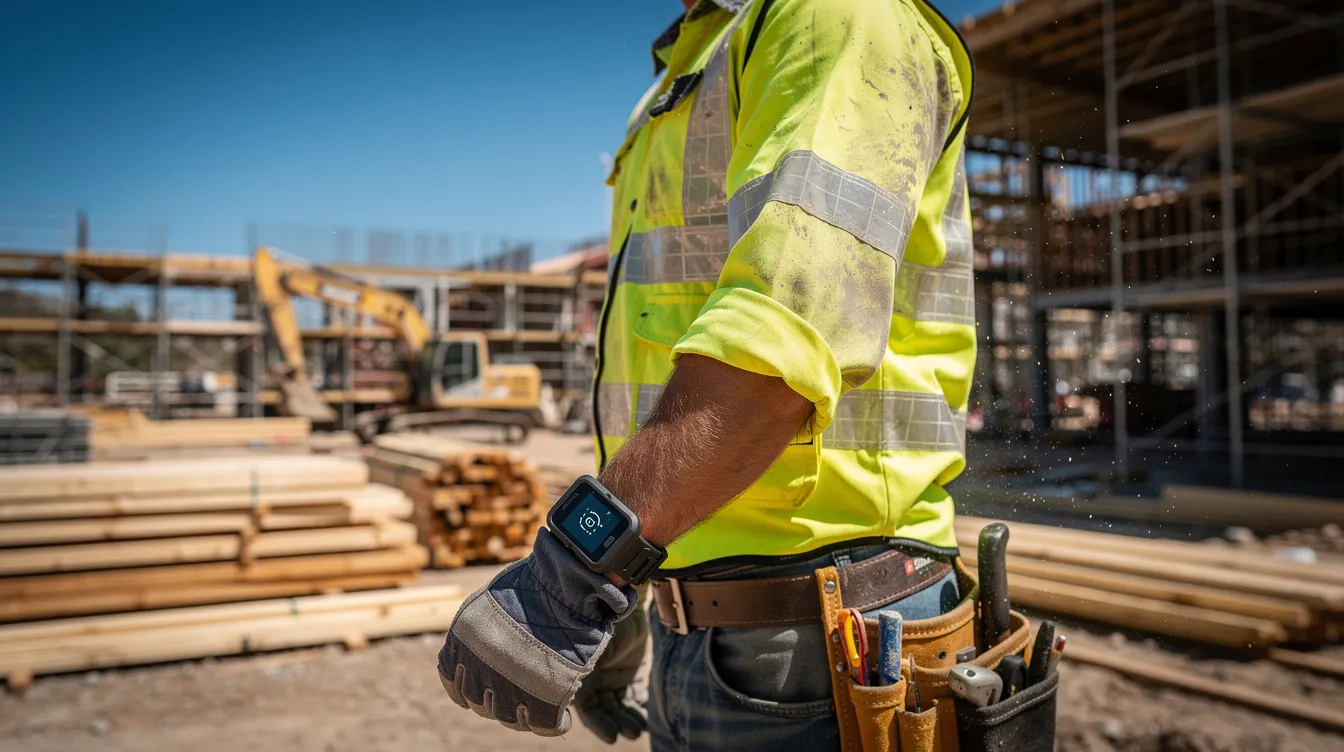
Safety management is shifting from manual inspections to real-time hazard monitoring. Translating that monitoring into daily operations requires discipline at the supervisor level.
Translate indicator thresholds into daily checklists. If the heat index exceeds 90°F and wearable data shows crew members nearing fatigue thresholds, the shift-start checklist should include a heat huddle, hydration monitor assignment, and extra break scheduling. Field safety plans identify and mitigate construction risks, and they should flag elevated-risk areas or project-specific hazards rather than relying on a generic template.
Require documented toolbox talks when indicators cross thresholds. If PPE compliance drops below baseline or near-miss frequency spikes, the supervisor leads a documented toolbox talk that same day, noting attendees, discussion topics, and corrective actions.
Use digital jobsite displays to share verified risk signals. Monitors or LED boards showing current risk levels (heat risk, compliance percentage, active hazard zones) create transparency, encourage peer accountability, and reinforce a safety culture across trades.
Track supervisor interventions as part of workplace safety audits. Auditors should evaluate not only whether data was collected but whether supervisors acted on it, how quickly, and what the outcome was. Response time becomes a measurable indicator of safety performance.
Technology adoption fails when it is imposed from the office without field input. Building buy-in requires deliberate steps.
Involve foremen in vendor selection and pilot design. Foremen understand workflow constraints, trade interactions, and crew dynamics. Their input ensures the tool fits job site reality rather than creating additional burden. Safety managers should treat foremen as co-designers, not end users.
Run short field pilots with frontline crews before scaling. A 60- to 90-day pilot on a single project with clear success metrics builds credibility. Workers and employees who see the technology improve their daily experience become advocates rather than resistors.
Run targeted training explaining alerts and expected responses. Training programs enhance worker awareness of safety protocols and must cover what data is collected, what an alert means, who responds, and the limitations. Virtual and augmented reality are now used for immersive safety training scenarios that accelerate comprehension. Effective safety training reduces workplace incidents by 30%, and regular training updates improve compliance rates significantly. Training programs must be tailored to specific project hazards for maximum impact. Proper training bridges technology capability and field execution.
Publish a clear privacy and data-use policy for workers. Especially for wearables collecting physiological data, employees need to know what is collected, how long it is stored, who reviews it, and that the data serves safety rather than surveillance. Transparency minimizes resistance and protects the contractor legally.
Start with a phased pilot on one high-risk project type. Choose a project where risk is concentrated and measurable: heavy civil work along the I-85 corridor, a large commercial build in Charlotte, or a data center project in the Triangle. Select one predictive tool, whether PPE detection via computer vision or heat and fatigue monitoring through wearables. Building Information Modeling helps identify safety problems during project planning, so consider integrating BIM reviews into the pilot’s pre-construction phase as well.
Set a 60- to 90-day pilot with predefined success metrics. Metrics should include PPE compliance percentage, inspection completion rates, near-miss reporting volume, supervisor response time to alerts, and crew feedback scores.
Enroll foremen and subcontractors in pilot onboarding sessions. Every trade and subcontractor on the pilot project must understand the technology, the thresholds, and their responsibilities within the decision framework.
Measure leading indicators and supervisor responses weekly. Use dashboards and weekly site reviews to track whether alerts were seen, verified, and acted upon. Identifying gaps early allows course correction before the pilot concludes.
Link rollout decisions to pilot performance and crew feedback. Only scale if data shows measurable improvement and crews report that the process is fair, manageable, and functional. Adjust governance rules based on what the pilot reveals.
Set numeric improvement targets for each leading indicator before the pilot begins. For example, move PPE compliance from a baseline of 80% to 95% within 90 days, increase near-miss reporting by 50% to capture more weak signals, and achieve 100% pre-task plan completion for tasks involving fall risk or work at depth. AI can reduce lost workdays by 65% across construction sites when predictive tools are paired with consistent field response. AI platforms have reduced total recordable incident rates by 50% in well-implemented programs, with documented efficiency gains in schedule protection and cost avoidance.
Define a supervisor response-time KPI: verification of alerts within 15 minutes, toolbox talks within 24 hours, and corrective actions completed before the next shift. Report pilot results quarterly to senior leadership and project owners, including trendlines, comparisons versus prior periods, and crew satisfaction data.
Consult counsel on data ownership and worker privacy rules. Physiological data from wearable sensors may trigger ADA or health data considerations under North Carolina and South Carolina law. Construction companies should define who owns the data, who can access it, how long it is retained, and whether it can be used for purposes beyond safety. Stored data security must meet current regulations.
Align technology use with merit shop performance and accountability. Merit shop practices value objective measurement, fair competition, and individual accountability. Predictive safety tools should reinforce those values by using transparent, consistent metrics across all trades and subcontractors rather than creating arbitrary surveillance. This alignment helps minimize bias and protect the integrity of safety processes.
Document vendor responsibilities and data-retention obligations. Contracts with technology vendors must specify who maintains the system, who updates models, how false positives are handled, and what happens to data if the contract ends. Review these obligations alongside existing safety regulations and quality standards.
Within the first month of exploring predictive construction safety technology, contractors should take these steps:
For contractors ready to go deeper, these ABC Carolinas resources connect directly to the governance and field execution priorities outlined above:
Contractors who treat predictive safety as a governance discipline rather than an IT experiment will protect their people, defend their schedules, and lead this industry forward. Start your pilot this quarter.


