


ABC’s July 2026 Construction Backlog Indicator just posted its sharpest monthly drop in years, and the signal for Carolinas contractors is clear: construction safety planning belongs at the top of every executive’s response list right now.
ABC’s July 2026 construction backlog indicator fell to roughly 8.0 months nationally, down 0.8 months from both June and a year earlier, as reported by Construction Executive on August 11, 2026. Every region and firm size saw declines. Yet the South remains the only U.S. region with a year-over-year backlog increase, keeping the Carolinas relatively stronger but under intensifying pressure to deliver existing work without missteps. Construction has the third-highest fatality rate among industries, and a comprehensive safety plan protects workers and keeps job sites running safely-especially when schedules tighten and crews stretch.
What Carolinas executives should do now:
The Construction Backlog Indicator measures months of work under contract but not yet completed, giving construction companies a forward-looking view of their runway. It is not a bid list or a pipeline estimate-it reflects signed, contracted backlog only.
In July, as reported by Construction Executive, the indicator fell to approximately 8.0 months, slipping 0.8 months from June’s reading of roughly 8.8 months. Every industry segment, every U.S. region, and every firm-size category experienced some decline. ABC’s Construction Confidence Index for sales and staffing also softened, though profit margin expectations ticked slightly higher. All three readings remain above the 50 threshold, signaling cautious optimism rather than contraction.
Key data points for Carolinas construction professionals:
A lower reading does not mean demand has collapsed. Many construction professionals in the Carolinas still report near-full calendars, particularly in industrial corridors and data center segments. But the direction matters.
The South remains the only U.S. region with a year-over-year construction backlog increase-a distinction that keeps the Carolinas in the nation’s highest-demand band even as the national average declines. Southeastern backlog has been running roughly 0.4–0.9 months above the national average through early-to-mid 2026, a pattern detailed in ABC Carolinas’ earlier ABC backlog analysis for Carolinas contractors.
This creates two simultaneous realities for general contractors and industrial contractors operating in North and South Carolina. First, more competition arrives as out-of-region firms chase Southern backlog strength. Second, firms already under contract face more pressure to execute existing work flawlessly-where project delays or accidents carry outsized financial consequences.
Smaller firms and specialty contractors with a realistic backlog of 5–7 months feel this more acutely than larger firms with multi-year data center and infrastructure contracts. Merit shop principles promote fair competition in construction, and that open competition works best when firms compete on quality, safety, and workforce capability-not on who cuts corners fastest. These regional trends should inform decision-making around hiring, equipment purchases, and bidding discipline, not trigger panic.
Executives need to distinguish three different signals:
“Soft backlog”-verbal awards, letters of intent, framework agreements-can disappear quickly when owners pause or rebid, especially in commercial and office segments. Ethical bidding strategies help maintain profit margins in construction by ensuring that pursuit decisions are grounded in realistic costs and schedules rather than wishful thinking.
Leaders should reconcile ABC National data with their own WIP reports at least monthly. ABC Carolinas’ mid-year construction economic forecast provides additional context on how these indicators interact for firms in the Carolinas. Track both backlog dollars and new awards to understand your true runway before committing overhead.
Despite the July 2026 backlog decline, certain Carolinas corridors remain structurally strong. Charlotte continues to see concentrated activity in data centers, healthcare, and light industrial along the I-85 corridor, as detailed in ABC Carolinas’ Charlotte market executive briefing. Subcontractor capacity across electrical, mechanical, low-voltage, and structural concrete scopes remains the primary delivery risk in that market.
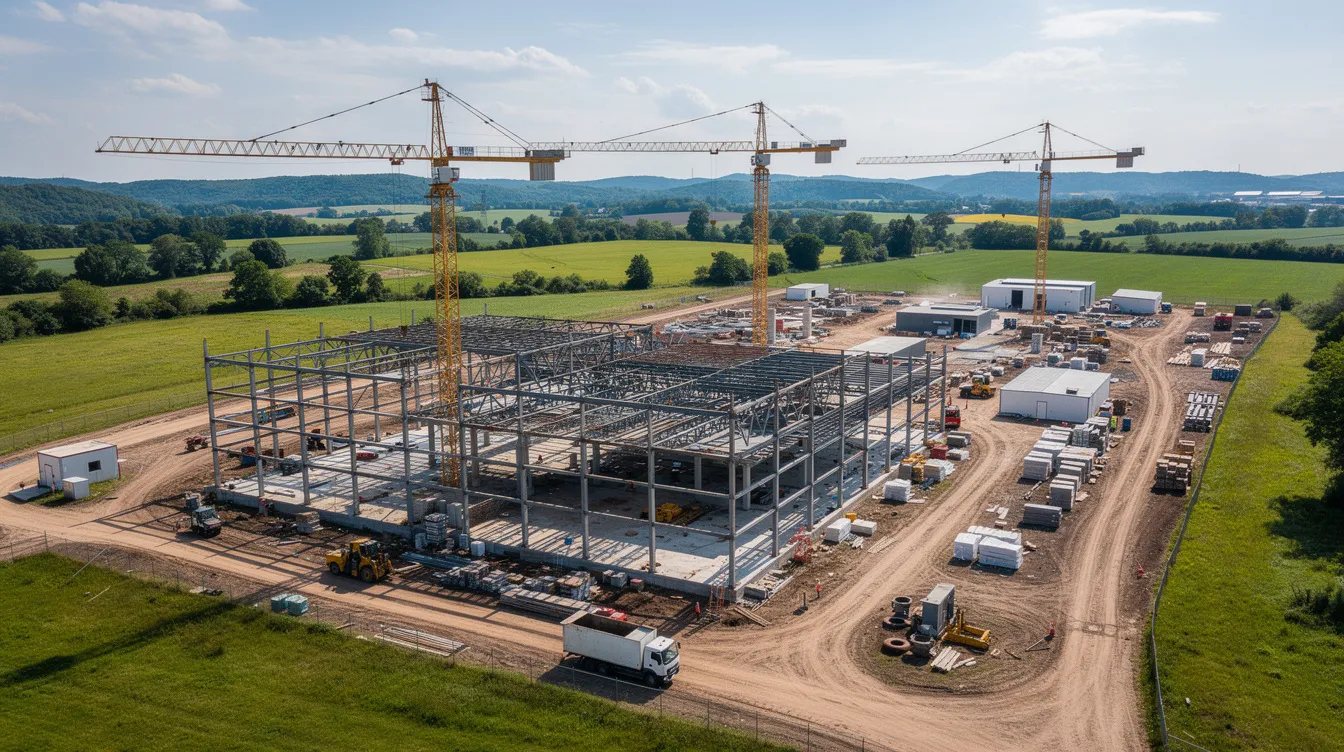
The North Carolina data center corridor-spanning RTP to the Triad and along major power-transmission routes-drives multi-year backlog for electrical, civil, and mechanical contractors. These construction sites carry heightened schedule, utility, and safety complexity. Environmental regulations can extend permitting timelines for industrial projects in these corridors, and developments such as Texas Governor Abbott mandating stricter oversight of data center grid connections signal that utility-related scrutiny is tightening nationally. Sustainable construction practices are increasingly mandated by regulations, adding layers to project planning.
Upstate South Carolina and the I-85/I-26 area continue to attract logistics hubs and advanced manufacturing investment, sustaining construction backlog for general contractors even as national manufacturing facility numbers soften. But smaller firms and specialty trades not directly on large data center projects may sit at a 5–7-month backlog, making disciplined construction safety planning and crew utilization critical to staying competitive. Pricing volatility in materials and supply chains adds further risk to thin margins.
Tighter margins and shorter construction backlog make unplanned incidents dramatically more expensive for Carolinas firms. When construction professionals respond to backlog pressure by compressing project schedules, stacking trades, or adding weekend shifts, the risk of falls, struck-by incidents, and equipment accidents rises-especially for smaller firms without robust safety departments. Safety training significantly reduces workplace injuries, yet the temptation to skip steps grows when revenue is uncertain.
Construction safety planning should be viewed not as a reactive checklist but as a continuous management process. It integrates safety into preconstruction, sequencing, and staffing decisions. Management’s commitment to safety defines accountability across all project tiers, and management leadership establishes safety as a core organizational value and enforces accountability from the executive suite to the job site.
Well-structured safety planning reduces rework, project delays, workers’ compensation costs, and EMR impacts-directly protecting gross margin when the construction backlog indicator moves lower. Margin erosion from a single serious incident can erase profit on multiple projects. Executives in the Carolinas should treat safety planning as part of monthly backlog and WIP reviews so staffing, schedules, and risk controls are adjusted together, not in separate silos. This is how you protect workers and protect revenue simultaneously.
Every major project in the Carolinas-whether a data center, hospital, school, or industrial facility-should have a written, site-specific safety plan. OSHA requires written safety plans for certain construction activities, including hazardous activities such as work involving fall protection, excavation, and energized systems. A site safety plan outlines risk management on construction sites and must address every operational phase, from mobilization through closeout.
Core elements include:
| Element | What It Covers |
|---|---|
| Hazard identification | Risk identification includes listing specific dangers and corresponding control measures. Hazard identification and job safety analysis evaluate worksite risks systematically. Job hazard analysis breaks complex tasks down to identify potential risks. |
| Hierarchy of controls | Hazard controls prioritize elimination before administrative controls or PPE. |
| Roles and responsibilities | Superintendent, foremen, safety coordinator, competent persons-each with clear authority. Construction managers should create site-specific safety plans and enforce the use of PPE. |
| PPE requirements | Personal protective equipment must be listed in safety plans for each task and exposure. |
| Emergency action plans | Federal regulations require emergency action plans for construction sites. An emergency action plan details protocols for various incidents. Emergency procedures should cover a range of foreseeable incidents and barriers. Emergency planning must address various situations workers may encounter on-site. Emergency plans should include clear evacuation routes and medical contacts. Clear emergency response protocols include visible instructions for foreseeable emergencies. |
| Emergency contacts | Effective safety plans include emergency contact information. Construction safety plans should include emergency contact information. |
Good construction safety plans are site-specific, practical, and updated continuously. A site-specific safety plan integrates proactive hazard identification and continuous training, meaning it evolves as site conditions change.
Regional examples:
Even companies under $30 million in revenue can maintain practical, written plans scaled to their crews. The plan does not need to be a hundred pages-it needs to be accurate, accessible, and enforced.

Effective construction safety planning connects office-based preconstruction decisions with field execution, bridging estimators, project managers, and superintendents. During preconstruction, teams should incorporate safety milestones into phasing plans, logistics layouts, and subcontractor scopes-especially on occupied campuses, healthcare facilities, and active industrial plants where site work overlaps with ongoing operations.
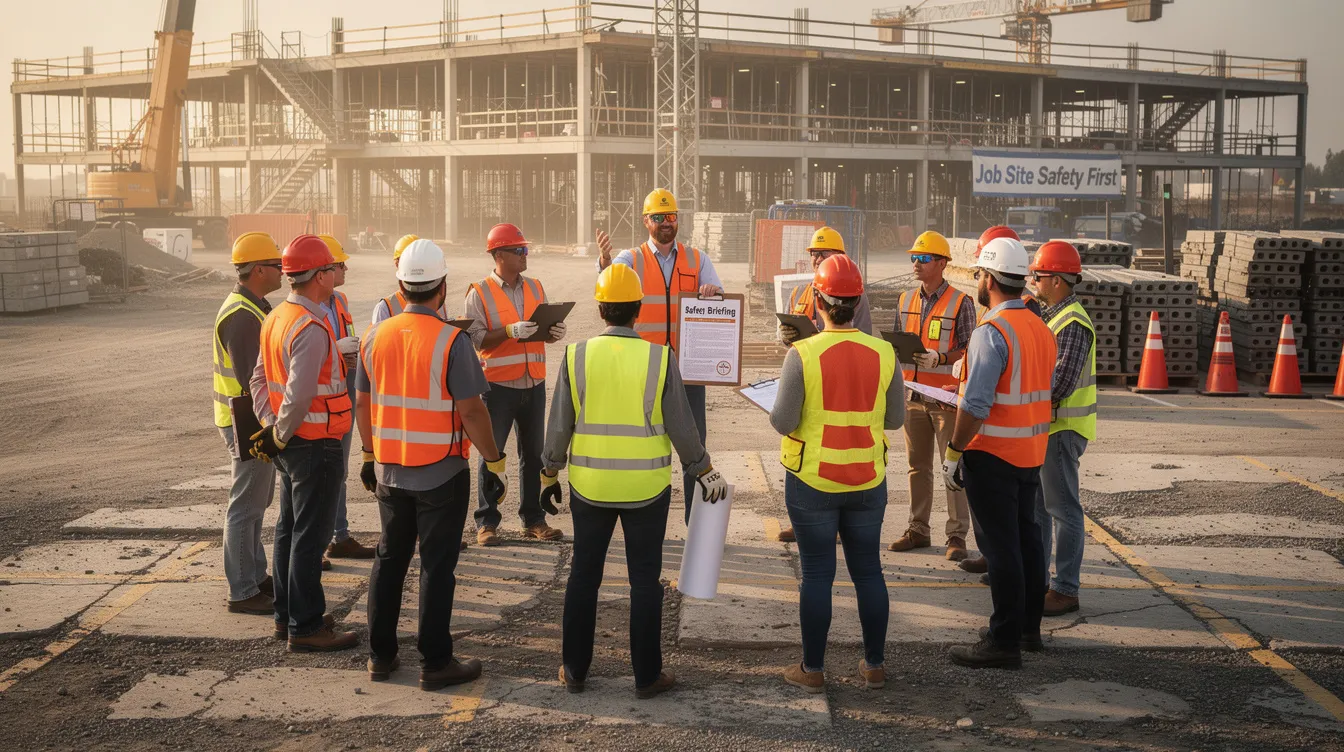
Training includes site orientation and task-specific training for workers before they set foot on a new project. Training ensures workers are certified for high-risk tasks as mandated by standards. Regulatory compliance ensures workers receive ongoing, task-specific training throughout the project lifecycle.
Daily field execution requirements:
Incorporating worker insights in safety planning is crucial for identifying hidden hazards that supervision may miss. Incident reporting protocols establish a framework for logging injuries and near-misses so patterns surface before they become accidents. Integration of safety technology streamlines reporting and compliance checks, helping firms track observations in real time. Continuous improvement involves treating the safety plan as a living document-updated when conditions, sequences, or crews change.
Mini-scenario: A data center project along the I-77 corridor faces a compressed switchgear delivery window due to long lead times and supply chain delays. The project manager adjusts the schedule to stack electrical and mechanical trades in the same bay. The site-specific safety plan has been updated: a revised JHA covers overhead work, proximity to energized equipment, and crane swing radius. Foremen brief crews in both English and Spanish. The window is met without unsafe shortcuts-because safety, logistics, and schedule were adjusted together.
Labor shortages are the number one constraint on growth in 2026. ABC Carolinas offers apprenticeship programs to build workforce capacity, and contractors report spending more on recruitment and training initiatives to close the gap. But hiring decisions must align with contracted backlog, not hopes.
A late-summer decision checklist for executives:
Ethical practices enhance contractor reputation and client trust-especially when construction companies compete for fewer awards. Firms that demonstrate strong growth in safety culture win repeat work and attract better talent in a tight labor market.
ABC Carolinas serves as a hub for construction professionals seeking to integrate backlog intelligence, workforce development, and safety programs into a single coherent strategy. The association helps members win work and deliver projects safely, ethically, and profitably.
Members can pair monthly ABC National releases-the construction backlog indicator and confidence indices-with ABC Carolinas briefings such as the mid-year construction economic forecast and ongoing nonresidential spending trends to time investments in safety training and equipment. ABC Carolinas advocates for ethical standards in construction practices and connects that advocacy with practical resources.
Key offerings relevant to construction safety planning:
Assign a senior leader-COO, safety director, or VP of operations-as the “market and safety planning owner” who regularly attends ABC Carolinas events, monitors backlog data, and translates insights into updates for the company’s site-specific safety plans and hiring strategy. Do not navigate July’s backlog signals in isolation.
Carolinas contractors should track these indicators through late 2026:
Executives should schedule a late-summer review that pairs backlog projections with an audit of construction safety planning for their top five to ten projects, confirming that schedule assumptions, workforce plans, and safety controls still align. The construction industry in the Carolinas is recalibrating, not contracting. Informed decisions made now-on hiring, on project planning, on safety-define which firms enter 2027 with a strong backlog, healthy margins, and a workforce ready to perform.
Your next step: Contact ABC Carolinas to register for an upcoming safety training, join a peer roundtable, or attend an economic-briefing event. Refine your safety and staffing strategies before 2027 bids lock in. The firms that plan now will be the ones that deliver later.

When the backlog shortens, firms often pursue more bids and compress schedules, increasing risk. Focus your safety planning on controlling overtime, tightening pre-task planning with JHAs for every new activity, and ensuring each new pursuit includes realistic safety and staffing assumptions. Use the backlog threshold as a trigger to reassess-not abandon-safety investments. Avoid overloading crews to chase revenue, since one serious incident can cost more than the project earns.
Yes. OSHA requires certain written safety plans for hazardous activities regardless of firm size, and North Carolina’s OSH Division enforces these standards through its state plan. Even for projects that fall below federal thresholds, a concise written plan-covering hazard identification, emergency procedures, PPE rules, and competent-person assignments-reduces incidents and protects your EMR. Scale the document to the project, but always document it.
Apprentices support hazard observations, participate in job hazard analyses, assist with housekeeping and basic controls, and serve as additional eyes on changing conditions. They must receive structured training and close supervision. ABC Carolinas’ apprenticeship programs build this capacity from the start, ensuring newer construction workers contribute to safety culture rather than creating additional exposure. Productivity improves when newer workers are properly oriented and mentored.
Data center work entails higher electrical and mechanical risks, tighter commissioning schedules, more concurrent activities by specialty trades, and complex lockout/tagout and energized-work controls. Fall protection requirements during structural and rack installation are more intensive. Early, detailed construction safety planning is essential for both general contractors and specialty trades on these projects, particularly given the concentration of potential hazards in confined equipment rooms and near high-voltage infrastructure.
Absolutely. Fewer incidents mean less rework, lower workers’ compensation premiums, and a healthier EMR-which directly reduces insurance costs across all projects. In a softer backlog environment, even one serious accident can trigger project delays, liquidated damages, and reputational harm that erases profit on multiple jobs. Safety planning is a financial discipline as much as a moral one, and firms that treat it that way consistently outperform those that view it as overhead.


