


Artificial intelligence is arriving on the Carolinas’ job sites faster than most safety programs can absorb it. The question for commercial contractors is not whether to adopt AI, but how to govern it so that every safety-critical decision still has a named human behind it. This article lays out a practical framework for construction safety leadership in an AI-assisted environment, built for the risk realities of North Carolina and South Carolina.
Construction safety leadership in an AI-supported environment means that superintendents, project managers, and safety directors continue to own every risk decision on their construction sites, while using artificial intelligence as a data-gathering and pattern-recognition layer. AI can assist construction safety management by organizing incident logs, drafting pre-task plans, and surfacing trends, but it cannot replace accountable supervisors who walk the deck, verify conditions, and enforce stop-work authority.
AI tools have moved beyond pilot programs. In 2025 and 2026, construction professionals are using machine learning algorithms and generative AI for schedule look-aheads, concept budgets, safety plan drafts, and incident summaries. Each of these touchpoints carries risk: when an AI system generates a pre-task plan that a superintendent sends to crews without a walkthrough, the planning process bypasses the field judgment that catches what data cannot.
The stakes are severe. U.S. construction and extraction workers suffered roughly 1,032 fatalities in 2024, with falls, transportation incidents, and harmful-substance exposures leading the count. Businesses spend $170 billion annually on occupational injuries across all industries, and construction absorbs a disproportionate share. Construction managers must prioritize worker safety throughout projects, and leaders must visibly prioritize safety over speed and profit in construction-especially when AI makes speed easier to chase.
As Groundbreak Carolinas explored in its 2024 article on “cognitive submission,” the real danger is not that AI gives bad answers. It is that construction professionals stop questioning those answers. McFarland Construction’s AI pilot in Charlotte demonstrated measurable efficiency gains, but its leadership warned that AI must be used with human scrutiny rather than as a substitute for professional judgment.
For ABC Carolinas’ audience-merit shop commercial contractors and subcontractors operating across North Carolina and South Carolina, the central question is governance: how do we use AI so it strengthens, rather than weakens, field judgment and ethical considerations? This article builds on the ABC Carolinas safety-first culture guide and zooms in specifically on AI-era controls.
Construction safety leadership has always been defined by daily behaviors: the superintendent who stops a crane lift in Charlotte because the rigging looks wrong, the foreman on an Upstate SC data center build who pulls a crew off a deck during gusting winds, the safety director who rewrites a JHA after walking a trench. These decisions require the knowledge needed to identify safety hazards in real time, authority to act, and personal accountability for outcomes.
When AI enters construction project management, leadership roles shift. Project managers now set boundaries around which AI tools are approved, interpret AI-generated outputs before they reach crews, and ensure safety protocols are not overridden by algorithmic suggestions. Effective construction safety leadership involves continuous communication and education-not just about physical hazards, but about how technology fits into the decision-making chain. OSHA mandates that management lead safety and health programs, and that mandate does not change because a software platform is involved.
Fostering safety leadership requires a culture-driven approach in construction. In an AI environment, strong construction safety leadership requires:
Construction safety programs must focus on management leadership and worker participation. Workers should be actively involved in hazard identification and safety planning, whether the hazard was flagged by a sensor, a camera, or a coworker’s observation. Leadership in safety fosters a culture of accountability on job sites-and that culture must extend to how teams interact with AI outputs.
The line between useful support and dangerous automation is not always obvious. Here is where it falls for construction sites in the Carolinas.
Appropriate support uses where AI adds value under human oversight:
Decisions that must stay human-led-no exceptions:
AI models may be trained on outdated standards or non-Carolinas codes. Safety leaders must validate outputs against current OSHA guidance and state-level resources from NCDOL and the South Carolina Department of Labor, Licensing and Regulation before acting.
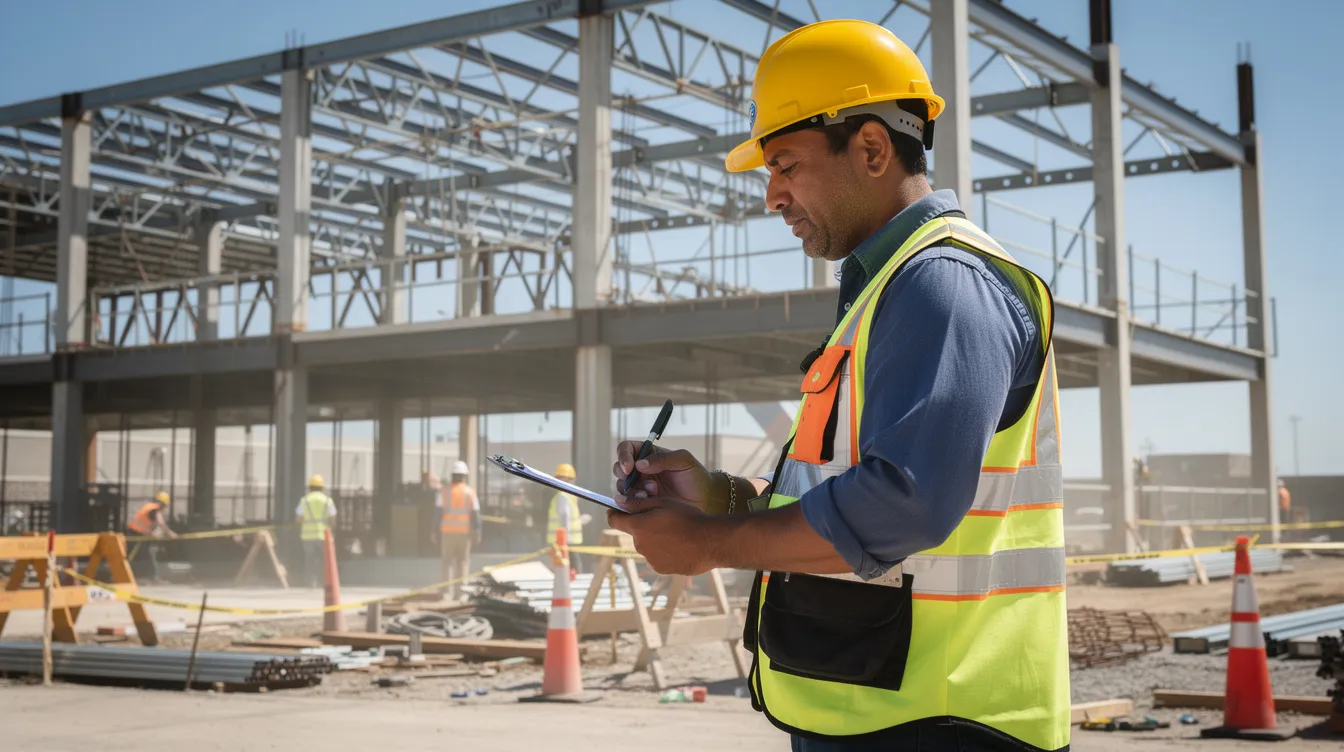
Carolinas example: On an Upstate SC tilt-wall project, AI software flags potential fall hazards on decking areas based on drone imagery. The competent supervisor inspects the flagged areas, walks the deck, and decides to shut down a bay where guardrails are incomplete. AI identified the area; the human made the call.
AI should plug into the existing construction management structure, not create a parallel chain of command. A decision hierarchy keeps the right people accountable at every level.
Step-by-step hierarchy for safety-critical calls:
This hierarchy should be written into the company safety manual and reinforced during supervisor training. Integrating safety into daily huddles keeps it top of mind before work begins, and AI-surfaced data should feed those huddles rather than replace them.
Construction leaders should use leading indicators to measure preventive safety activities. Shifting metric tracking from lagging to leading indicators promotes proactive risk management, and AI can help by surfacing observation rates, near-miss trends, and inspection completion data as key performance indicators. Regulatory compliance in construction should be integrated into daily operations, not treated as separate-and the same applies to AI governance.
Set explicit “non-negotiables”: lockout/tagout, trenching deeper than five feet, work at height over six feet. In these areas, AI inputs help target inspections, but no work proceeds without physical verification. ABC Carolinas members can connect this hierarchy to the broader construction safety management playbook so AI oversight becomes part of the same operating system as toolbox talks, observations, and incident investigations.
When AI influences a safety decision, the record must show what happened, who decided, and why. This aligns with the documentation expectations covered in ABC Carolinas’ guidance on OSHA compliance documentation and inspections.
Capture these elements every time AI touches a safety workflow:
AI systems can automatically update compliance protocols and checklists in real time, but those updates still need human review before they change field operations. Include AI-influenced decisions in routine safety meeting minutes and incident investigation forms so that during OSHA inspections or insurance reviews, leaders can demonstrate that technology supported-but did not dictate-construction site safety actions.
Set retention periods for AI-generated safety logs consistent with other safety records, and periodically audit a sample of AI-influenced decisions for quality and compliance. Use this documentation framework alongside STEP enrollment, internal audits, and peer benchmarking to demonstrate maturity in construction safety leadership.
Every firm using AI in construction safety management-even informally through ChatGPT for safety memos-should have a written policy that field teams can follow without confusion.
Core sections of an internal AI safety policy:
| Section | What It Covers |
|---|---|
| Approved use cases | Drafting toolbox talks, summarizing OSHA updates, analyzing anonymized incident data, generating training reminders |
| Prohibited uses | Making termination decisions, editing incident reports to minimize severity, weakening safety protocols to hit deadlines |
| Human review steps | Every AI-generated safety document reviewed by a named supervisor before use on construction sites |
| Recordkeeping | Documentation requirements for AI-assisted safety decisions, aligned with OSHA and company retention rules |
| Data privacy | Clear communication that monitoring data is used for worker safety, not surveillance for discipline |
Training should focus on competence rather than mere attendance in safety practices. OSHA requires employers to provide sufficient safety training, and that requirement extends to ensuring supervisors understand how AI fits their workflow. Effective safety training can reduce injury costs by 20 to 40 percent-but only when the training produces real skill, not checkbox compliance.
The policy must state explicitly that AI cannot override the authority of the competent person on site, the superintendent, or the designated safety manager. Any conflicts default to stricter safety measures. ABC Carolinas members can review draft policies with ABC Carolinas safety staff or peer groups to ensure practicality and alignment with regional best practices.
Before adopting AI-powered tools for construction site safety, construction firms should vet vendors with these questions:
Pilot tools on one or two projects-a Charlotte healthcare build or a Triangle industrial site-with clear performance metrics: near-misses identified, documentation time saved, user feedback from field teams, and zero tolerance for unreviewed AI decisions. ABC Carolinas has explored similar guardrail thinking around contracts in its coverage of AI tools for contractor risk review, and the same discipline applies to construction site safety and incident documentation tools.
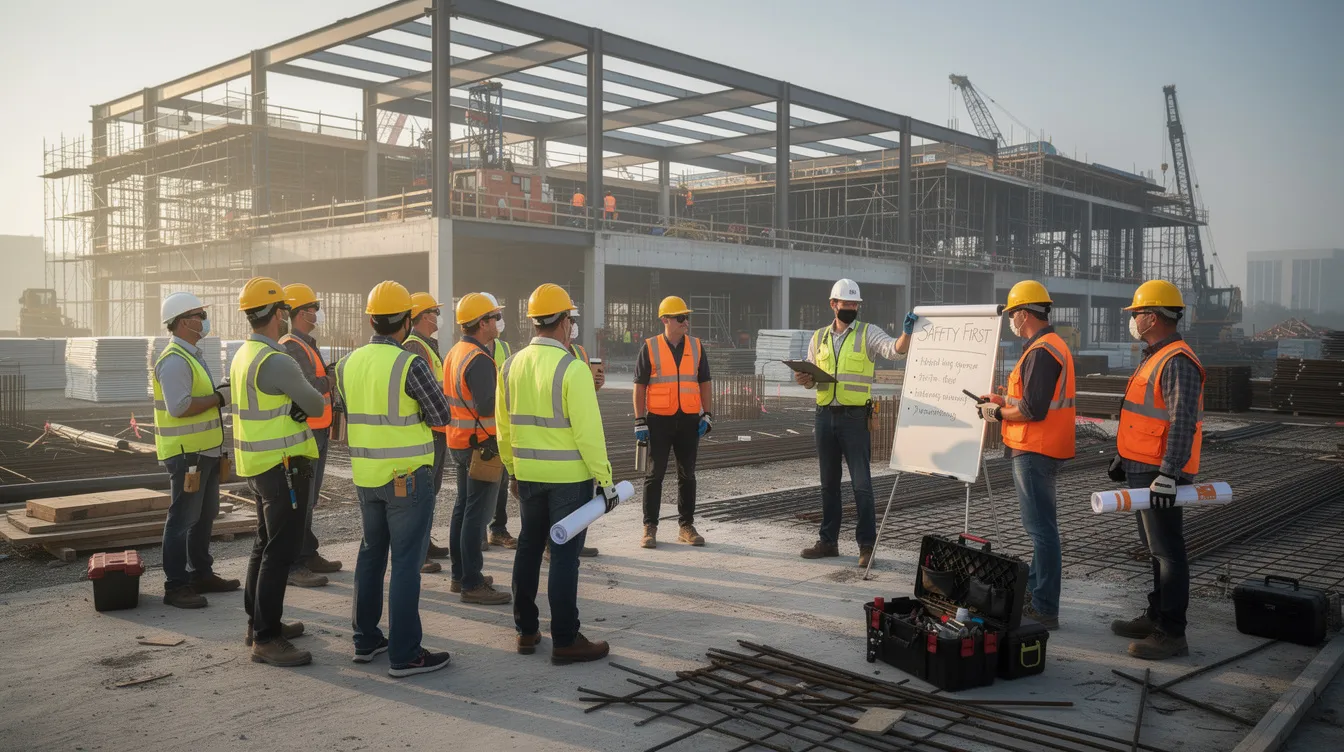
Using innovation to improve workplace safety and free-enterprise performance is core to ABC Carolinas’ mission. But AI monitoring cameras, wearables, and real-time monitoring feeds can erode trust if workers believe the data will be used for punishment rather than protection.
A blame-free environment encourages workers to report near-misses and hazards. AI-enabled observations should be treated the same way as human-reported near-misses: focus on eliminating hazards and fixing systems before assigning blame. Construction companies should:
Public recognition of safe behaviors reinforces a positive safety culture in construction. Effective safety management systems can save millions in injury costs, but only when the workforce trusts the system enough to participate. Integrate AI expectations into safety recognition and peer observation programs so technology reinforces personal responsibility rather than replacing it.
Fast growth around Charlotte, the Triangle, the Wilmington and Charleston ports, and Upstate South Carolina is producing larger, more complex, multi-employer job sites. Data centers along the North Carolina corridor, industrial expansions near I-85 and I-77, and institutional projects across the region are adding layers of subcontracting, heavy lifts, and elevated work. North Carolina’s construction fatality rate has run at roughly 11.5 per 100,000 workers in recent years-double to triple the statewide average. With 63.7% of construction fatalities due to the Fatal Four, the margin for error is thin.
Construction companies can reduce injury costs by 20 to 40% with robust safety systems, and firms that demonstrate defensible AI guardrails-documented oversight, clear escalation paths, and OSHA-aligned records-will be better positioned with owners, insurers, and regulators. Safety performance is increasingly a competitive advantage in bidding, retention, and client confidence.
The merit shop philosophy rewards companies that combine innovation with strong safety outcomes through open competition, rather than chasing lowest cost by cutting corners or over-automating safety roles. Executives should benchmark current practices against the construction safety management playbook and peer companies in ABC Carolinas regional councils.
Here is a concrete action plan for the next 30 to 90 days:
AI should strengthen, not weaken, the chain of accountability in every safety-critical decision on your jobsite. Contact ABC Carolinas or visit the website to register for upcoming safety and technology sessions focused on construction sites across North and South Carolina.
These questions address practical concerns Carolinas contractors raise when first integrating AI into construction site safety workflows.
Start with a single, low-risk use case-such as using AI to summarize incident logs or draft toolbox talks-and require a supervisor to review every output before it reaches the crew. Run a 60- to 90-day pilot on one construction project with clear metrics: time saved, accuracy of outputs, and number of human overrides. Once the team is confident in the process, expand to a second workflow. Smaller safety committees benefit from keeping the scope narrow enough to make informed decisions without adding headcount.
Yes. Even occasional use, such as running a JHA through ChatGPT, should be acknowledged in the company safety program and AI policy. Clarify that AI content must be reviewed by a competent supervisor, that human roles remain accountable for every safety decision, and that documentation should note when AI assisted the output. OSHA requires employers to provide sufficient safety training, including ensuring your people know the rules around AI-generated materials.
Combine OSHA-focused supervisor training-such as OSHA 30 or ABC Carolinas leadership courses-with a company-specific AI orientation covering approved tools, guardrails, escalation rules, and how to document AI-assisted decisions. Safety strategies work best when training focuses on competence rather than attendance, so build scenario-based exercises into orientation. Cover what to do when AI flags a hazard, when to override a recommendation, and how to record the rationale.
Adopt a standard company-wide AI safety policy and integrate it into pre-job planning and project kickoff meetings. Require each construction project’s safety plan to reference the AI policy and name the roles responsible for oversight. Use regular management reviews or ABC Carolinas peer groups to compare how different projects are applying the guardrails, share what works, and identify safety issues before they become trends.
Under current OSHA expectations and industry best practices, AI cannot replace a qualified safety professional or competent person. AI-powered systems extend a safety manager’s reach-scanning sites, surfacing patterns, monitoring continuous data feeds-but the knowledge needed to interpret conditions, make judgment calls in dynamic environments, and enforce stop-work authority is fundamentally human. Treat AI as an additional tool that improves the quality of construction safety management decisions, not a substitute for the people making them.


