


Competent person excavation is central to the decisions explored in this guide. Material prices are not done testing Carolinas contractors. Even as month-to-month swings have cooled, the elevated baseline costs of steel, copper, electrical gear, and concrete continue to threaten margins on every fixed-price bid moving through Charlotte, the Triangle, and Upstate South Carolina. This article delivers the operational playbook your team needs before the next major submittal.
Construction procurement strategy is now central to how Carolinas contractors protect bids and schedules when material prices and lead times remain unstable, even in late 2026. Estimators and project managers in Charlotte, the Triangle, and Upstate South Carolina must tighten quote validity windows, clarify escalation language, and align contingencies with clearly documented assumptions.
Procurement risk is not just about cost. It directly affects schedule reliability, cash flow, and the ability to meet project quality standards on hospitals, data centers, industrial facilities, and public work along the I-85 and I-77 corridors.
ABC Carolinas members can use regional market intelligence on construction material prices in 2026, tariff transition risks, and the mid-year construction forecast to inform buyout timing and contract decisions.
What follows is a practical playbook contractors can apply before their next major bid, with clear steps on what to monitor, what to negotiate, and how to assign procurement risk across the project team.
Construction input materials in North and South Carolina rose roughly 7.0% year over year through early 2026, with 6.2% of that increase concentrated in just the first four months. That pace outran the cumulative 4.8% inflation seen across 2023 through 2025. By July 2026, month-to-month movement had essentially flattened, but the year-over-year baseline remains stubbornly elevated. Steel pipe and tube costs are up about 12.5%, cement roughly 7.7%, and copper has surged approximately 32%. Price fluctuations at this scale can significantly impact project financial planning on any commercial job in the region.
A construction procurement strategy, defined in concrete terms, is the coordinated set of decisions a contractor makes about when and how to lock in materials, negotiate terms, and manage potential risks between estimate, award, and completion. It is not simply a purchasing function. Construction procurement strategy affects delivery speed, cost certainty, and flexibility across every phase of the job.
Consider a distribution center bid in Charlotte or a hospital expansion in Raleigh-Durham. A 5 to 10% swing in steel or electrical gear pricing between bid day and buyout can erase the entire margin on fixed-price work. Several Carolinas contractors have reported exactly that gap when supplier quote validity windows expired before award. Input volatility is now a contract management and risk allocation issue, not only a purchasing concern. Executives must treat it as part of overall project governance and quality standards.
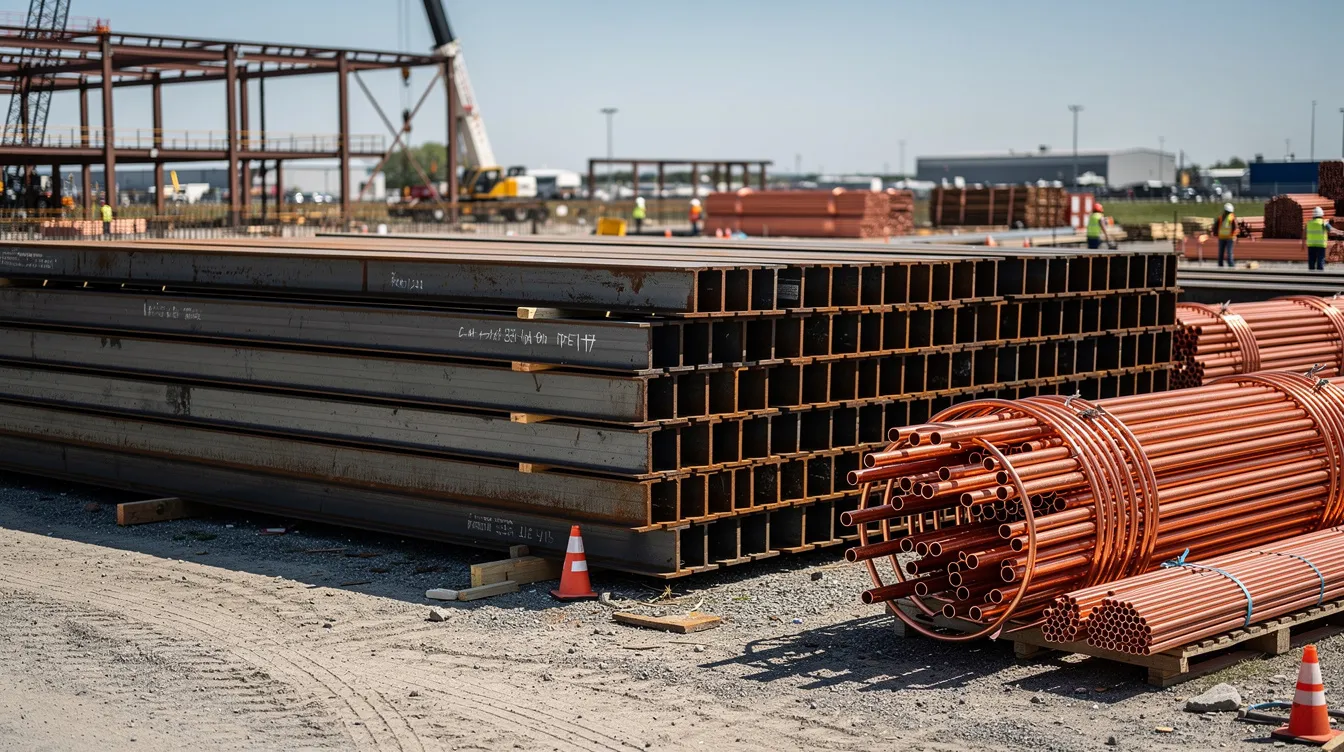
In practice, construction procurement strategy translates into decisions estimators, project managers, and executives make every week on real jobs in North and South Carolina. It determines how a project owner acquires services and how contractors protect their position from estimate through closeout. Construction procurement strategies shape how materials and services are acquired, and choosing the right procurement strategy dictates cost control and risk mitigation at every stage.
Core objectives of a strong strategy include:
Procurement strategies can shift risks to the party best equipped to manage them. This principle supports the merit shop philosophy by rewarding performance, transparency, and fair competition rather than shifting all risk downstream to subcontractors or suppliers who may not be positioned to absorb it.
The rest of this article moves from market awareness to category-specific risks, and then to play-by-play tactics for bids, contracts, and cash flow.
Some input categories remain far more volatile than others in 2026, and procurement teams need to prioritize their monitoring and early-buy decisions accordingly.
Structural steel and rebar remain subject to Section 232 tariffs and domestic production constraints. Steel pipe and tube is up approximately 12.5% year over year, and fabricated steel lead times fluctuate sharply.
Copper and non-ferrous metals are leading the cost surge. Copper wire and cable prices are up roughly 22.3% year over year, with primary non-ferrous metals soaring as much as 62% in certain indices. Demand from data centers and infrastructure is a major factor.
Electrical switchgear and transformers show acute lead-time volatility. On projects along the North Carolina data center corridor, medium-voltage switchgear is quoting 10 to 14 months, and some transformers now quote 60 to 120 weeks. These items are determining project schedule, not just cost.
Mechanical equipment, roofing, and concrete each carry their own risk profiles. Cement is up roughly 7.7%, and roofing materials are sensitive to oil and diesel price swings. Large slab footprints on tilt-wall and distribution center projects are especially exposed.
Supplier reliability is a key procurement risk across all of these categories. The difference between price volatility, lead time volatility, and allocation risk matters: price can be hedged, lead times require early commitment, and allocation risk (where distributors hold minimal stock) demands relationship management.
What to track weekly versus monthly:
| Frequency | What to Monitor |
|---|---|
| Weekly | Supplier bulletins, freight surcharges, availability alerts from major manufacturers, country-of-origin changes due to tariffs |
| Monthly | Aggregate index-based inflation (BLS PPI), labor rate increases, tariff developments, backlog indicators |
A unified internal approach is essential before submitting a fixed-price bid on a school, hospital, or distribution center in the Carolinas in late 2026. Without a common view of escalation, quote validity, substitutions, or supplier risk, post-award cost overruns or delays can silently erode profit. Early contractor involvement improves constructability and reduces design conflicts, and that same principle applies internally: the earlier your teams align, the better the outcome. Early contractor involvement also prevents costly mid-construction redesigns when procurement assumptions are shared across disciplines from the beginning.
Specific coordination steps:
Executive sign-off checklist before committing to a large fixed-price award:
The period between when subcontractors and suppliers finalize pricing and bid submission is where many Carolinas contractors either protect or lose margin. Quote validity in volatile material categories has shrunk from a traditional 30 to 60 days down to 7 to 15 days in many firms. That compressed time frame is the bid-stage decision window.
Shorter quote validity windows. For structural steel, switchgear, and copper wiring, request quotes valid for no more than 10 days. In contracts, require that subcontractor quotes include notice if revalidation is needed. Communicate that constraint to owners and construction managers early so it does not become a point of friction at award.
Alternates and value-engineering options. Competitive bidding drives down costs while maintaining quality standards, but only when contractors offer meaningful choices. Price both a base specification and a cost-stable alternative. For example, bid with premium switchgear on a shorter lead time and an alternate with standard specification but longer lead time or possible escalation.
Delivery models affect how escalation language works. Design-Bid-Build separates design from construction with competitive bidding, while Design-Build combines design and construction services under one contract, often with more flexibility on material choices. A Construction Manager at Risk guarantees a Maximum Price during pre-construction, giving both owner and contractor a defined ceiling. Value-based procurement focuses on contractor qualifications rather than lowest bids, and integrated strategies allow construction to start before design is complete, which can reduce exposure to mid-project price jumps.
Escalation clause example: “If primary steel mill product indices increase more than X% from bid date to contract execution, contractor reserves the right to renegotiate the price of that scope based on a published index.”
Communicating protections. In proposals, include a brief narrative: “Due to elevated volatility in copper and electrical gear, this bid limits the validity of these items’ quotes to 10 days and includes an escalation clause tied to a published index.” In owner and CM interviews, share recent examples where volatility eroded margin or caused delays. Owners who understand the contractor’s exposure are more likely to accept reasonable protections.
Construction procurement strategy becomes real at the subcontract and purchase order level. This is where risk is either clearly assigned or left vague and contested. Clear contractual agreements minimize the risk of disputes, and contract disputes can disrupt project timelines and budgets on any job in the Carolinas.
Scope and delivery specifics. Detailed scopes of work should specify material grade, origin, quality, and performance requirements. Delivery milestones must be explicit. Include substitution rights tied to both pricing and quality standards, but only with pre-approval and matching specifications.
Escalation and lead time terms. When to seek fixed prices versus shared risk depends on supplier confidence and project timing:
| Condition | Recommended Approach |
|---|---|
| Supplier demonstrates stable domestic production | Fixed price |
| Cost increase beyond agreed band (e.g., 5%) | Shared risk, passed through proportionally |
| Commodity-linked material (copper, steel) | Index-linked escalation tied to BLS PPI |
Long-term framework agreements reduce repetitive bidding time for projects and give suppliers confidence to hold better pricing. Relational strategies reduce disputes and litigation risks during projects, especially when both parties have skin in the game.
Supplier prequalification. Conduct thorough background checks on suppliers to mitigate risks. Establish clear performance criteria for supplier evaluation, covering financial strength, delivery history, safety performance, and inventory buffers. Maintain open communication channels with suppliers to better manage lead time and allocation challenges. Supplier management practices ensure reliability and performance in a market where delays cost significantly.
Carillion’s liquidation in 2018 resulted from unsustainable bidding practices, a reminder that pushing all risk downstream eventually collapses the supply chain. Disciplined subcontracts support the merit shop model: transparent, performance-based agreements enable fair competition and long-term partnerships.

In a volatile market, pressure to substitute materials or shorten procurement windows can unintentionally undermine project quality standards and regulatory compliance. When budget or schedule challenges arise, teams may propose cheaper materials or longer-lead substitutes. Without rigorous submittals and approvals, these may fail to meet code, performance, safety, or warranty requirements, especially in healthcare and data center work.
Contractors should structure submittals, mock-ups, and approvals so that value-engineering or substitutions never compromise code requirements, owner performance criteria, or safety obligations. ISO 9001:2015 is a quality management systems standard that provides a framework for ensuring consistent quality even when materials or suppliers change. ISO 45001:2018 is a standard for health and safety management that supports procurement decisions aligned with jobsite safety. ISO 22301:2019 certifies business continuity management systems, which is relevant when evaluating supplier resilience. Additionally, ISO 9001:2015 certification in a supplier’s operations can signal disciplined quality controls worth factoring into prequalification.
Compliance includes adhering to safety and environmental regulations at every stage of material selection and installation. Regulatory compliance avoids penalties and project delays. The Social Value Act 2012 promotes community growth through compliance and, while originating in the UK, reflects a broader trend toward procurement policies that account for social and environmental impact alongside cost.
Potential risks that arise with long-lead substitutions include mismatched warranties, coordination clashes in MEP systems (where an electrical gear substitution could change size, weight, or cooling requirements), and failure to meet hospital or data center specifications. Procurement teams should work proactively with design teams and owners to pre-approve alternate products that meet or exceed original quality standards before they become schedule emergencies.
Staying ahead of changing codes and enforcement trends in the Carolinas reduces rework and unplanned delays, ensuring that projects are completed on scope and on time.
Procurement volatility connects directly to backlog health, especially for contractors carrying significant work along the I-85, I-77, and I-95 corridors and in fast-growth metros like Charlotte and the Triangle. As of July 2026, the ABC backlog indicator for 2026 dropped to 8.1 months, signaling softening in the pipeline even though cost pressures remain. Large firms (above $100M revenue) carried roughly 2.2 more months of backlog than the same time last year, while smaller firms saw contraction.
Pricing uncertainty affects when to convert awards into firm backlog. Awards should be converted only when key materials are locked or escalation clauses are agreed; otherwise, contractors risk being locked into margin losses. Staging material buyouts requires balance: early procurement of long-lead items avoids price jumps but ties up capital, and stored materials become liabilities if site conditions or designs change.
Public-Private Partnerships involve private sector participation in public infrastructure, and these projects often carry extended timelines that amplify procurement risk. On any project form, every job should track material cost variance (estimated at bid versus actual committed) by category.
Cash flow strategies worth considering:
Decision framework for executives:
| Condition | Action |
|---|---|
| Long backlog, firm pricing available, risk categories locked | Hold |
| Mixed signals, some categories stable, others volatile | Hedge through timing (commit early on some, delay others) |
| Sharp projected cost increases, contracts not locked | Reprice or submit multiple pricing options with escalation |
Technology is changing how procurement decisions are managed across firms of every size. Digital procurement tools enhance visibility into spending and schedules, helping teams track quote dates, terms, lead times, and contract exposure in real time rather than discovering problems after the fact.
Practical tools include integrated estimating and project management systems that keep quote validity, approval status, and supplier reliability data visible to the whole team. Even smaller contractors can implement shared quote logs and templated escalation checklists without large software investments.
Data from recent bids, buyouts, and change orders reveals patterns. If a particular supplier or material category consistently shows a gap between bid pricing and actual committed cost, that pattern should inform future construction procurement strategy through more conservative estimates or higher contingency. Collaborative procurement methods encourage innovation in materials and designs when teams have the data to evaluate alternatives objectively.
Workforce skills matter as much as software. Estimators, assistant project managers, and emerging leaders must be trained to read contracts, understand procurement risk, and communicate clearly with suppliers and clients. ABC Carolinas’ leadership training, peer groups, and workforce development programs help members build these capabilities over time.
State and federal policies, including tariffs and procurement regulations, influence material pricing, supplier behavior, and contract risk for Carolinas contractors. The Section 122 tariff framework expired on July 24, 2026, and Section 301 replacement duties are creating new cost exposure based on country of origin. These tariff transition risks require procurement teams to understand which materials in their supply chain are affected and adjust quotes accordingly.
“Buy American” provisions and infrastructure funding streams can change access to, or the cost of, long-lead equipment and specialty materials. Integrated Project Delivery maximizes collaboration with shared risks and rewards, and that collaborative approach to risk becomes even more important when policy changes inject uncertainty into supplier pricing.
The merit shop philosophy supports resilient procurement by emphasizing open competition, transparent pricing, and performance-based selection. These principles help defend against supply disruptions and price shocks by encouraging multiple qualified sources and honest cost visibility rather than opaque, relationship-dependent pricing.
ABC Carolinas’ advocacy in Raleigh and Columbia helps maintain a regulatory environment that supports fair competition and flexible, market-driven procurement solutions. Contractors who stay connected to ABC Carolinas market updates can anticipate policy-driven price movements before they show up in supplier quotes.
This closing section pulls the article’s advice into a concise, operational checklist executives can use in the next 30 days.
30-day action plan:
Internal meeting agenda:
ABC Carolinas resources for members include detailed analysis on construction material prices for 2026, guidance on tariff transition risks, tools to help contractors protect their margins, and programming tied to the mid-year construction forecast. These resources translate market data into the kind of operational intelligence that keeps bids competitive and margins intact.
The contractors who protect margin in late 2026 will be the ones who treat procurement as governance, not paperwork. Engage with ABC Carolinas peer groups or upcoming events to compare procurement strategies with other contractors managing the same market conditions. The next bid is coming. Make sure your team is ready.

These questions address common follow-ups that Carolinas contractors have about procurement risk and strategy.
For highly volatile categories such as structural steel, copper, and switchgear, refresh pricing at least every two to four weeks while a bid is outstanding, and more frequently if suppliers issue new guidance or tariff rules change. For less volatile items, a monthly review tied to internal estimating meetings is sufficient, as long as teams update assumptions before major bid deadlines or contract negotiations. ABC Carolinas market updates help members decide when more frequent repricing is warranted based on regional trends and policy developments.
Smaller firms in markets like Wilmington, Columbia, or Asheville should assign clear procurement responsibilities to a specific estimator or project manager rather than spreading the task informally. Simple, standardized tools like shared quote logs, basic contract checklists, and templated escalation clauses bring structure without large software investments. Participation in ABC Carolinas training, peer groups, and networking events provides access to procurement best practices from larger firms and suppliers operating across the region.
Frame escalation language as a shared risk-management tool that protects project budgets and schedules against extreme swings, not as unilateral contractor protection. Bring concrete examples from recent Carolinas projects showing how modest escalation provisions prevented scope reductions or delays. Offer options such as a base price with limited escalation and an alternate with broader escalation but lower contingency, so owners choose the balance that fits their risk appetite.
Decisions about prefabrication, modularization, and long-lead equipment change the number of workers and types of tasks on site, which affects safety planning and training needs. A disciplined procurement strategy can reduce last-minute overtime and compressed schedules, which in turn lowers fatigue-related incidents and supports a stronger safety culture. ABC Carolinas safety training and apprenticeship programs give members tools to align workforce capabilities with evolving materials, methods, and supplier expectations driven by procurement choices.
Track the gap between estimated material cost at bid time and actual committed cost at buyout across major projects, reviewing this variance by category and supplier. A consistent pattern of negative variance signals a need to revisit quote windows, escalation assumptions, or supplier selection, while more stable performance indicates that procurement strategy is working. Pair this metric with regular reviews of work-in-progress reports so that procurement-driven cost shifts are caught early rather than buried in final job cost reports.


